
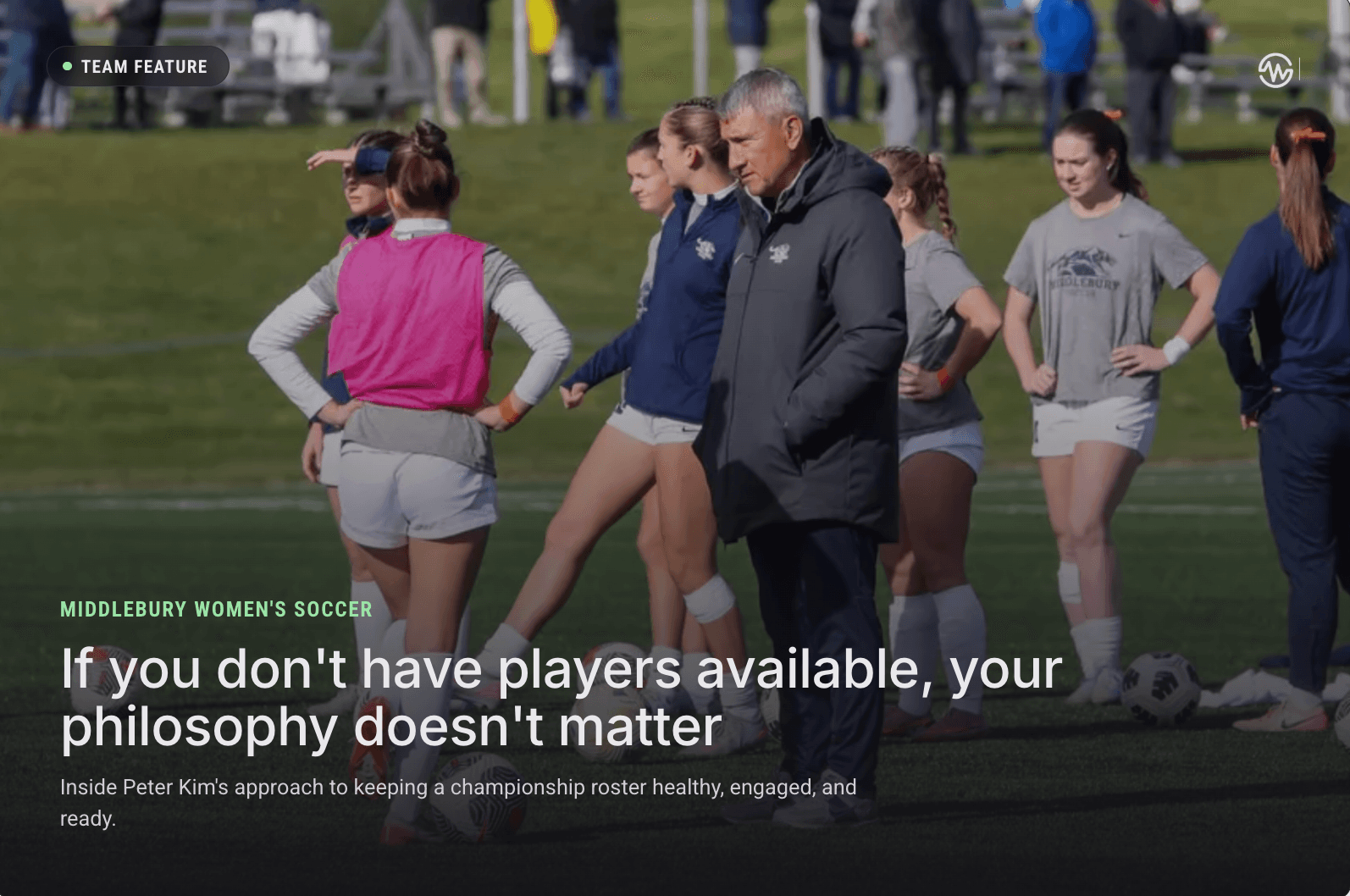
By the time Middlebury College's women's soccer team gathers for training, practice has already begun.
Before the first ball is struck, dozens of small decisions have already shaped the afternoon. Some players slept well. Others didn't. Someone is carrying the stress of an upcoming exam. Another skipped breakfast rushing across campus. A defender still feels soreness from the weekend match but hasn't mentioned it. A midfielder completes her morning wellness check on her phone while walking toward the locker room.
Each detail has the potential to influence what happens over the next ninety minutes. For Peter Kim, Middlebury's head coach since 2004, those unseen details have never been distractions from coaching. They are part of coaching.
Over more than two decades, Kim has built one of Division III's most successful programs, becoming the winningest coach in program history while leading the Panthers to four NESCAC championships, twelve NCAA Tournament appearances, the program's first NCAA Championship game appearance, and six NESCAC Coach of the Year honors.
"The American college soccer season is artificially short, Everything comes down to load management and recovery."
In a season where matches arrive every few days and recovery windows are brief, player availability becomes more than a medical concern. It becomes the foundation beneath every coaching decision.
"If you don't have players available to coach," he says, "your coaching philosophy doesn't matter."
That philosophy eventually led Kim to PlayerPulse, not because he needed more data, but because he wanted to make better use of the data he already had. He wanted a clearer picture of the athletes arriving at training each day. "It's easy to stimulate a conversation when you can see that they didn't eat well, or they're tired, or they're stressed," he says. It gives a coach the opening to ask another question, and have clear insight as into why they are tired, not eating well or are stressed.

For years, Middlebury tracked player wellness through Google Forms. Like many programs, the coaching staff collected responses every morning. The responses were there, but they rarely told the complete story. "We didn't have a way to integrate the qualitative component of what the team was feeling," Kim says. "That was a severe limitation."
Training observations lived in one place and conversations with athletic trainers happened somewhere else. An athlete's own perception of how she was feeling often remained disconnected from the rest. While each piece offered something useful, none provided a fuller picture before training began.
During the compressed rhythm of a college season, that timing matters. With only a day or two separating matches, coaches often have a narrow window to notice a concern before it affects training or availability.

Before players step onto the field, Assistant Coach Mark Sienko might review the morning wellness dashboard while an athletic trainer follows up with a player whose responses raised a concern. By warmups, the conversations have already begun.
"It's important to understand what is going on with your players, so you know what they need, and you can find that balance of how much to push them and when that is not what is going to help them succeed," Kim says.
That might mean asking a player how she's doing, modifying a training session, or having a conversation with sports medicine to make sure a minor issue isn’t escalated.
"This is a critical piece in connecting sports medicine in a more deliberate way," Kim says.
College athletic departments ask coaches, athletic trainers, strength coaches, nutritionists, and sports medicine professionals to work together more closely. Each sees the athlete through a different lens.
The challenge is ensuring those perspectives reach the people who need them before practice begins. Kim says PlayerPulse has helped make that possible.

"PlayerPulse makes what would otherwise be overwhelming, simple" he says. "With so much data on every athlete every day, you just can't actualize using the data otherwise. This way it's functional, it's intuitive."
Rather than asking athletes to remember another form or another login, the platform sends a simple daily reminder. Kim credits the team's consistently high response rates less to the technology itself than to the culture surrounding it.
"Because our players understand what this is for," he says, "they participate, and it's positive."
When Kim talks about player wellbeing, he rarely frames it as compliance. Athletes are more likely to engage, he believes, when they understand why something matters and trust it's intended to support them rather than simply monitor them.
Success is often measured by wins, lineup consistency, and performance. For most student-athletes, four years pass remarkably quickly. Practices, bus rides, lifts, film sessions, and matches that feel routine at the moment become the memories they carry long after the final game. Coaches shape that experience every day, not only through the sessions they design but through the decisions they make about the players participating in them.

Kim’s recruiting reflects that approach. Rather than encouraging families to chase the biggest name or the earliest offer, Kim encourages them to think carefully about fit. The right college, he believes, is the one where a student-athlete has the opportunity to grow, contribute, and enjoy four years that inevitably pass more quickly than anyone expects.
As any coach recruiting for the extremely rigorous academic programs in the New England Small College Athletic Conference, also known as “Little Ivies,” like Amherts or Tufts will tell you, you aren’t able to approach building your roster the same as other programs.
While Kim receives over 2000 recruiting inquiries every year, he communicates with each prospective student individually and tries to watch each recruit play before admissions decisions.
That same attention to detail, that same mindfulness carries into everyday coaching. Academic stress matters. So does sleep, nutrition, recovery, and mental wellbeing. None of those things stop affecting an athlete simply because practice has started.
"If you care about your players," Kim says, "you want them to have a good experience over the years you get to work with them, especially the experience they have in your weight room and on your field. It just makes sense."
Kim rarely speaks about athlete wellbeing as a competitive advantage, even though his record suggests it has become one between four NESCAC championships, twelve NCAA Tournament appearances, and six conference Coach of the Year awards. Simply, the winningest coach in program history.
Performance and wellbeing are less influenced by information alone than by the quality of the relationship between coach and athlete. For Kim, technology simply creates more opportunities for those relationships to deepen, and is another source of perspective before decisions are made. PlayerPulse simply gives coaches a clearer picture before those moments unfold.
Most of those moments are small enough that nobody outside the program ever sees them:
A coach pauses before training to ask how a player is feeling. An athletic trainer follows up after noticing a change in the morning check-in. A workload is adjusted before a minor issue becomes something more significant. Cones are set, and goals are wheeled onto the field. A player has completed her morning wellness check. An assistant coach has reviewed the day's responses.
Most of those moments will never be noticed outside the program. However, taken together, they reflect the attention that has defined Peter Kim's coaching.
Long before the first whistle blows, he has already begun coaching.