
They trainedwith data.3× fewer torean ACL.
An ACL tear takes a teenage athlete out for nine months to a year — surgery, rehab, and a real chance the injury reshapes their season, their scholarship, their relationship with the game. The question we set out to answer was simple: did the players using SoccerPulse get hurt less?
25 predicted.
8 actual.
At the national injury rate, a cohort of this size — 203,112 exposures — would be expected to suffer about 25 ACL tears. The SoccerPulse players suffered eight. That gap — roughly 17 injuries that statistically should have happened and didn't — is the story.
The raw rate
ACL injuries per 100,000 player-exposures. Lower is safer.
Two distributions that barely touch
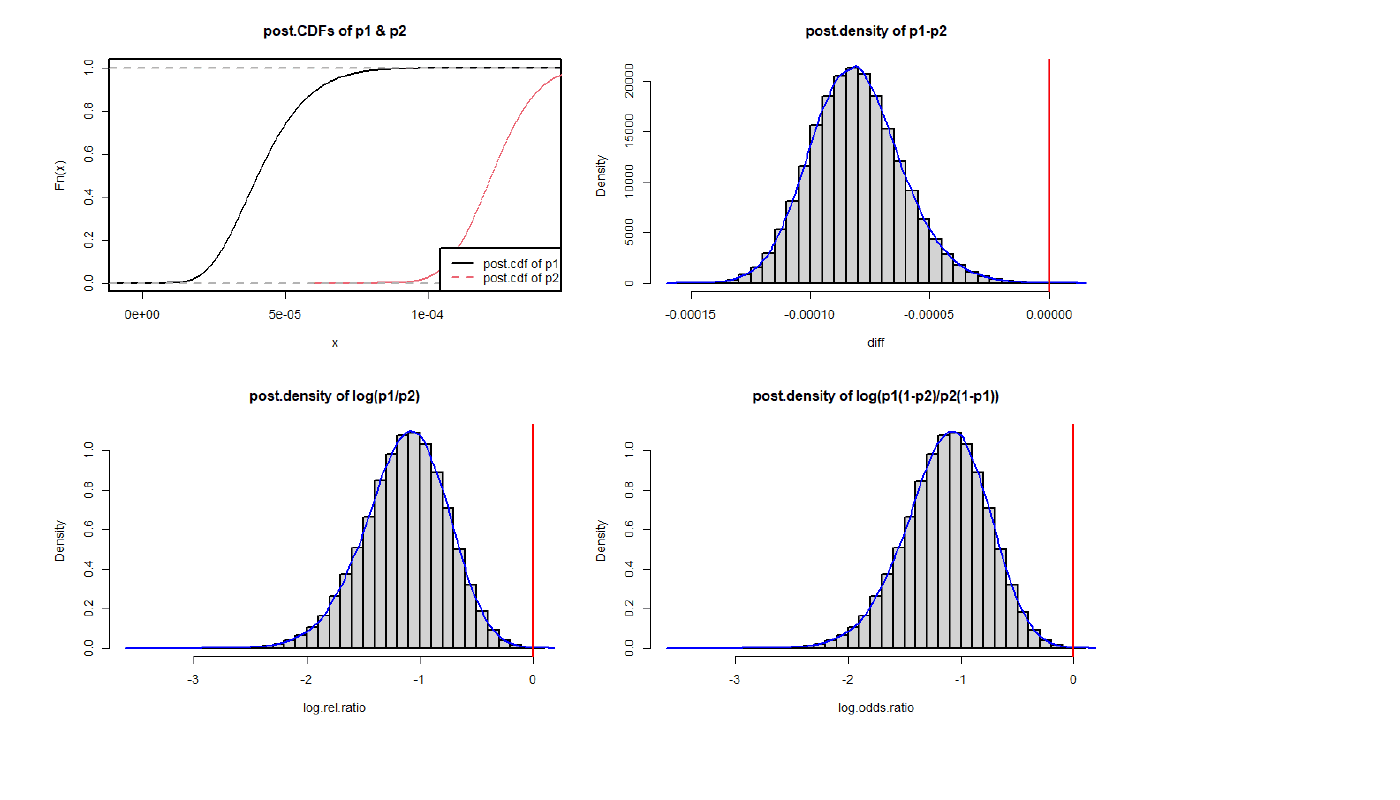
Rather than a single number, a Bayesian analysis produces a full distribution of plausible injury rates for each group. Here they are. The two curves sit almost entirely apart — the SoccerPulse cohort's entire plausible range falls below the benchmark's.
Posterior probability that the SoccerPulse rate is lower: 99.98%. The median estimate is a 3.03× reduction.
Even the most conservative end of the 95% interval still means a 50% reduction in ACL injuries.
probability SoccerPulse players are safer
For context, most clinical studies celebrate 95%.
The method
Because ACL injuries are rare events, the analysis used Bayesian inference with a Jeffreys prior and 100,000 posterior samples — the right tool for small proportions, where classical tests mislead. The benchmark comes from a peer-reviewed NIH study of US high school girls' soccer.
It wasn’t luck. It was visibility.
Every player generates signals every day. PlayerPulse turns them into the one question a coach can actually act on: is this athlete ready to train hard today?
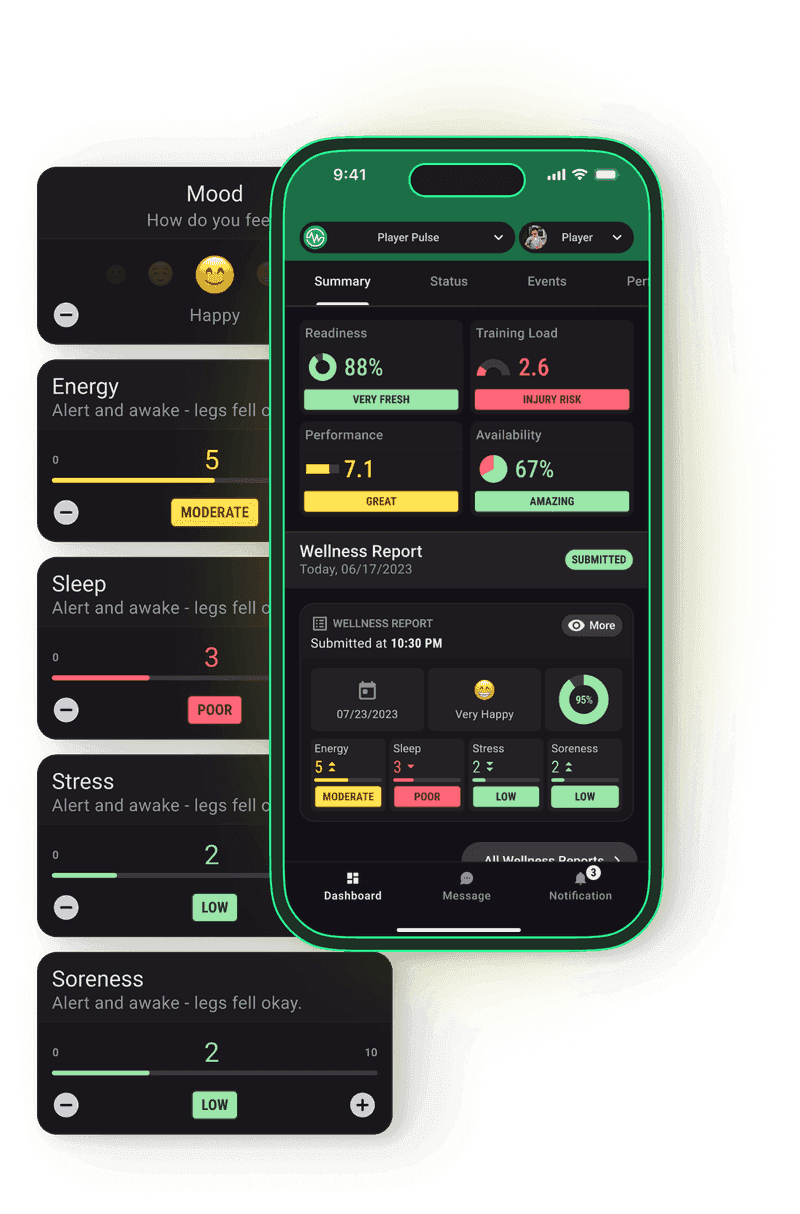
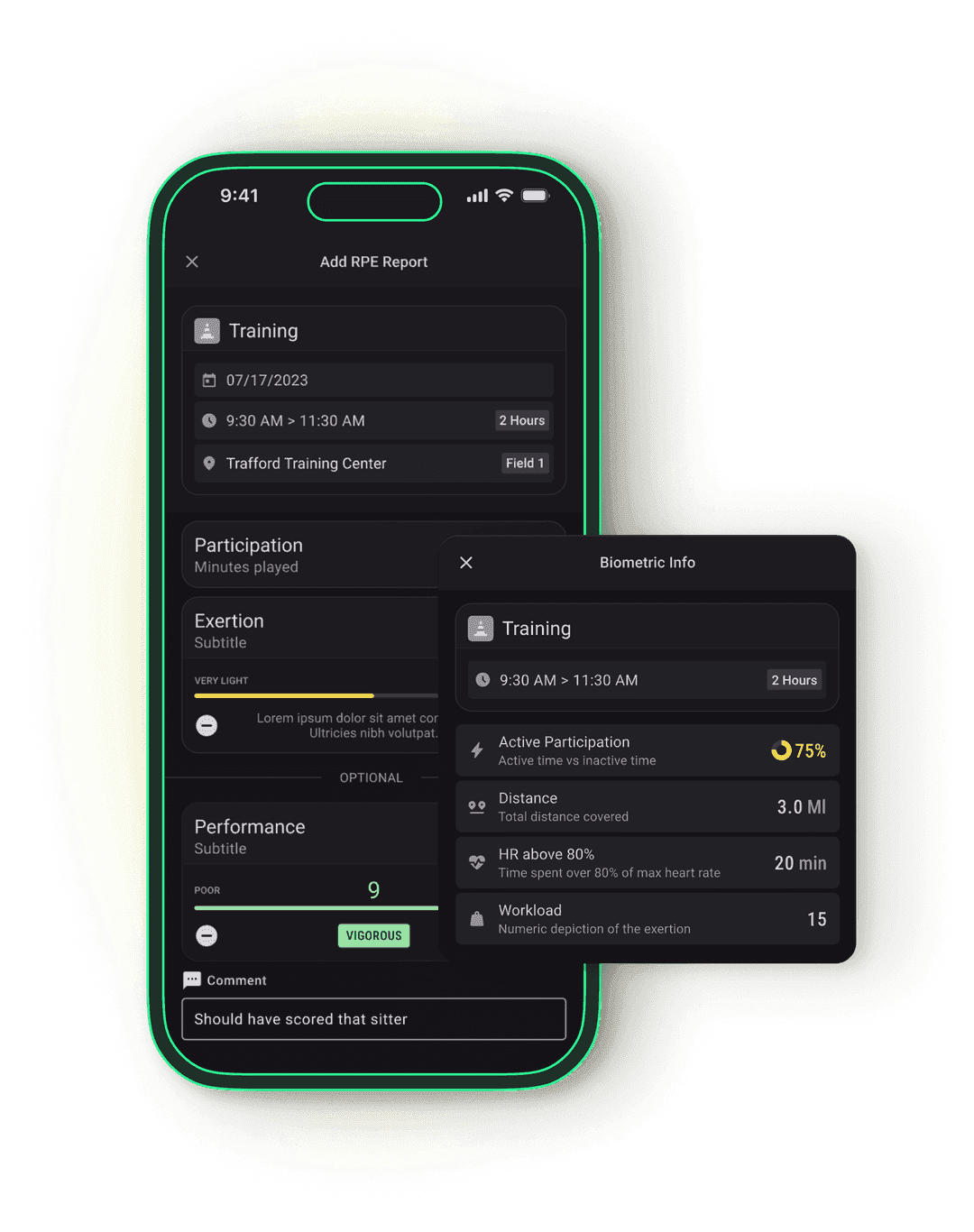
Real screens: the morning wellness report + readiness/training-load dashboard (load flagged as injury risk), and post-session RPE capture.
Daily wellness report
Each morning athletes log sleep, soreness, and stress. Accumulating fatigue surfaces days before it becomes an injury.
RPE after every session
A quick 1–10 effort rating turns “that felt brutal” into data — the real internal load carried by each individual body.
Training-load monitoring
Those ratings roll into acute-vs-chronic load. Sharp spikes — among the strongest predictors of soft-tissue injury — get flagged before the next session.
Readiness
Coaches see who’s primed and who’s running on empty, and adjust the plan. Know when to push. Know when to rest.
No single feature prevents an ACL tear. Seeing the whole athlete, every day, is what moved the number.
Better calls, for everyone
Coaches
Modify practice in real time — ease off the player who’s over-loaded, push the one with room to give. The right session for each body, that day.
Parents
Know when the extra training helps and when it quietly undoes the work at practice — when to push, and when to pause.
Players
Understand their own body, and share it — one quick daily check-in that keeps every coach and parent on the same page.
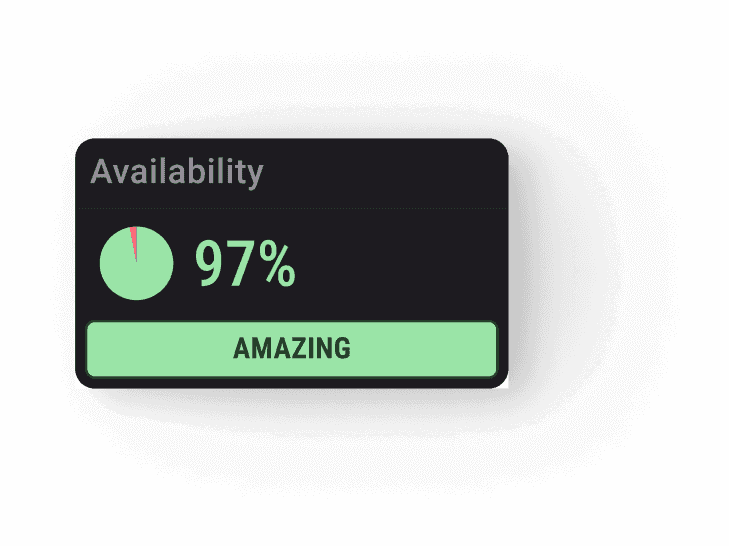
It all adds up to availability.
More athletes healthy and on the field, more often — measured across the whole squad and player by player. That’s the number every coach, parent, and player is really chasing.
Give your players the same edge.
The data every athlete generates, working to keep them on the field.