
History Made: An Arm Around All Twenty-Eight
The players who arrive in Hanover have spent years becoming exactly the kind of students Dartmouth hopes to attract. They stayed after practice when everyone else went home, rewrote papers that were already good enough, and learned to expect a little more of themselves than almost everyone around them because, more often than not, that was what success required. By the time they arrive on campus, they've already learned how to compete under pressure. What they are less likely to know is when carrying more stops being useful.
Taylor Schram has no interest in making their lives harder simply to prove that they can handle it.
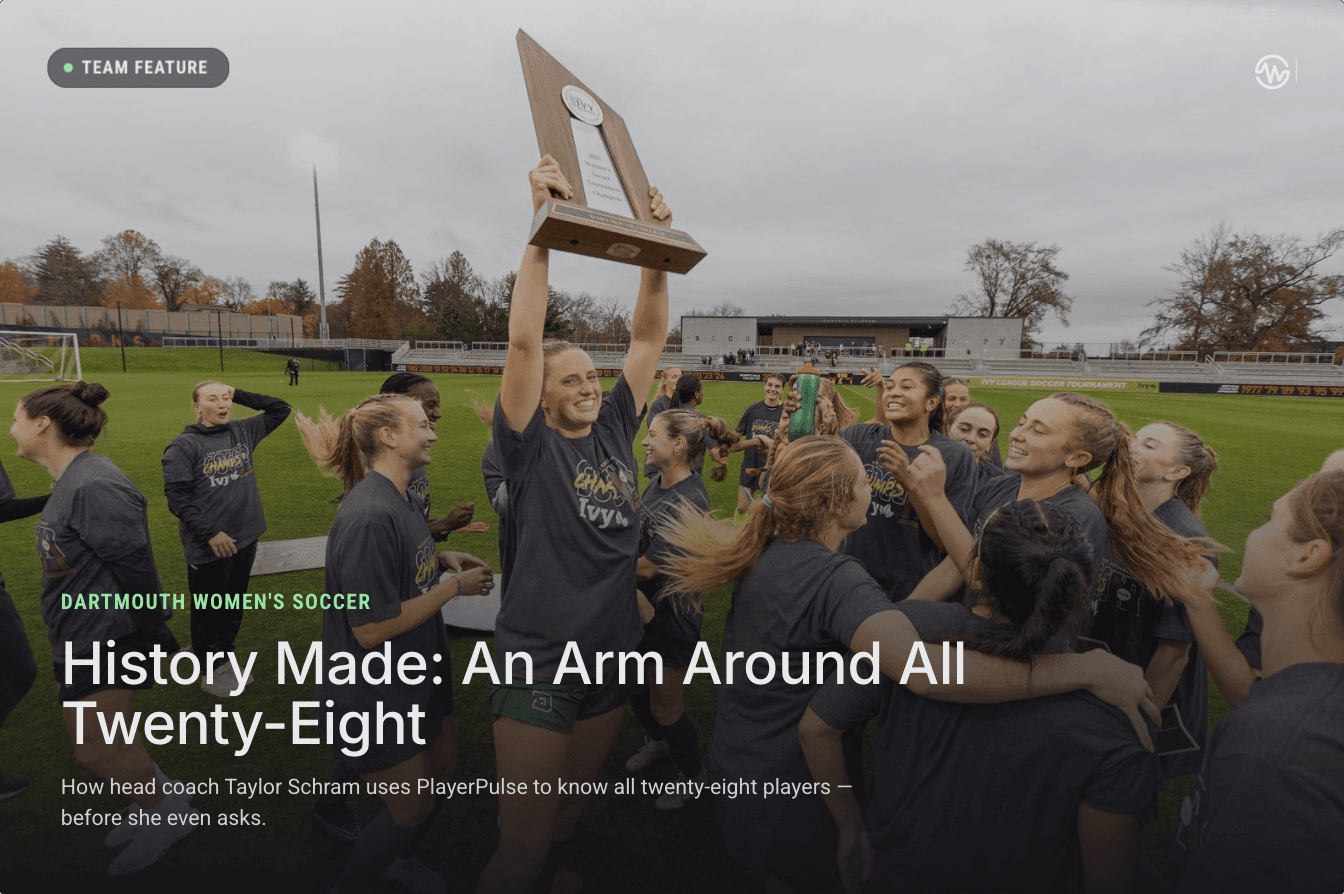
Last fall, Dartmouth captured its first Ivy League championship in twenty-two years. Schram, now entering her twelfth season as the Stacy Branca '94 Family Head Coach of Women's Soccer, and her staff were named Ivy League Coaching Staff of the Year after guiding the Big Green through one of the strongest seasons in program history. Five players earned All-Ivy recognition, and for the first time in more than two decades, Dartmouth had a championship to celebrate.
"We say this all the time," Schram says. "If you're just focused on game day, you're missing the point."
She talks about practice, about the hundred-plus days players spend together between games, and about what happens in all those ordinary hours when there is no trophy waiting at the end of the afternoon.
Most of a college career unfolds somewhere other than game day. Players arrive from class carrying backpacks, tape an ankle before training, recover with teammates, eat dinner together, study late into the evening, and wake up to do it again. A championship might occupy one afternoon. The days that lead there, and the days that follow, are where a college experience actually takes shape.
"I always say you get maybe eighty games if you're lucky," Schram says. "You might get one championship game. But we spend more than a hundred days together practicing. That's what matters most. That's where you enjoy it."
Schram's players are not short on ambition. Dartmouth recruits students who have already learned how to demand a great deal from themselves, and Schram sees the particular pressure that can come with that kind of achievement.

"They're unbelievably driven," she says. "Sometimes they're almost hardwired toward perfectionism."
They arrive knowing how to push. Schram wants them to learn something else, too: when the push is worth it, when it isn't, and how much more there is to college soccer than getting through the next hard thing.
"They already have so much stress in their lives. I want to make sure they're being challenged, yes, but also supported, and celebrated. I want this to be the best part of their day."
Ellie Davidson experienced that approach firsthand when Schram saw something in her game that she hadn't yet seen in herself. When Davidson arrived at Dartmouth, she had spent her entire playing career as a forward. During her freshman preseason, Schram began to see something else in her game.
"Taylor noticed something about my game before I ever saw it myself," Davidson says. "She believed I had the potential to thrive in a defensive role, even though I'd played forward my entire career up to that point."
Davidson wasn't immediately convinced. She had spent her entire career as a forward. Suddenly, Schram was asking her to see herself somewhere else.
"Honestly, I was unsure," she says. "But Taylor saw a skill set I hadn't fully recognized in myself, and she gave me the chance to prove it on the field."
The position change did more than alter where Davidson played. It changed what she understood about herself as a player.
"That belief and trust in me, it ended up changing the way I understood my own game entirely."

Schram knows something about redirection herself. She arrived at Penn State as a defender with professional ambitions of her own, but a serious concussion redirected her toward coaching. Graduate work at West Virginia led to coaching stops at Binghamton, Florida Gulf Coast, Boston College, and eventually Dartmouth. She's coached for more than a decade now, long enough to watch the demands on student-athletes change completely. NIL has changed what recruiting conversations sound like. So has the transfer portal. The expectations on student-athletes just keep growing.
The players walking into Dartmouth practice are carrying considerably more than soccer. One might have spent the previous night studying for an organic chemistry exam. Another is adjusting to the pace of an Ivy League classroom. Someone else is homesick, trying to find her place on a new team, or carrying something she hasn't yet figured out how to say out loud.
For Schram, the value of PlayerPulse is not simply that it gives her more information. It gives her another way to get closer to the players she is responsible for.

"Our athletes have so much going on," Schram says. "If they didn't have an avenue to tell us that, we'd miss a big part of what they're experiencing. I think it would be naïve, especially at an Ivy League school, to ignore that. Using PlayerPulse is like walking around with your arm around all twenty-eight players. You already know how they're doing before you walk up and ask."
Haley Dowd has spent enough time alongside Schram as The Big Green's assistant coach to see how that philosophy works beyond the training plan. "PlayerPulse is one of several tools we use to guide decisions," Dowd says. "We look at it alongside GPS data, training load, travel, and daily observations to provide context to help us map out the training week."
Some mornings, the first message a player gets is from Schram. Nothing long, just Good luck today, I know you've been stressed. "That relationship piece is more important than ever," she says.
"I think the smallest thing she does is always having her office door open for conversations, soccer or life," Dowd says. "It has helped the coaching staff create strong relationships with our athletes."
That openness matters most when a player is still learning that she doesn't have to have everything figured out. First-year players arrive at Dartmouth having spent years learning to handle things on their own, and sometimes the easiest answer is simply to say everything is fine.
The problem, Dowd says, isn't that players are looking for a way out of training. If anything, they tend to underreport what they're carrying because they don't want to disappoint the people around them.
"They'll tell us every day they feel great," Schram says. "They're telling me what they think I want to hear. I can see it in their face that they're not okay."
"Learning to advocate for yourself is really important," Schram says. "It gives players ownership. They have to have a voice in the room. They have to speak up and communicate. It's part of the learning process, and it is very much part of our high standards."
Not every player gets there right away.
One of the program's top recruits seemed to have that part figured out. She typically finished in the top three of the team's strength testing, trained relentlessly, and quickly earned the trust of the coaching staff. Her daily wellness reports suggested she was doing well.

"Great."
That was her answer, day after day. The reports reflected what she was telling the staff, but Schram noticed there might be more to understand.
The PlayerPulse report gave Schram a reason to look closer. The recovery numbers didn't match the one-word answer. What she found had less to do with soccer than with everything else the player was carrying into her first year at Dartmouth: homesickness, academic pressure, new friendships, and the feeling that she should be able to handle all of it without anyone noticing.
"We're asking these young women to do really hard things," Schram says. "To go through four years of college and assume something isn't going to happen in their life is silly."
Eventually, the player took one of Dartmouth's mental health days, a policy that gives a no-questions-asked day off, no explanations or justifications needed.
"It's not that I didn't believe it as a freshman, but as a senior I now completely understand the importance of details," added Davidson. "Filling out PlayerPulse on time, making sure the equipment is ready to go, and wearing the right gear are just a few of the small things that help set our team up for success. I now believe that paying attention to the details off the field translates directly to success on the field."
Those are the habits Schram wants from her players, and they're the ones she looks for long before they join the team. She watches for the obvious things like technical ability and athleticism. But she's really looking for the loose ball, and watching to see who is chasing every one of them down.
Does a forward sprint all the way back to defend? When the score gives a player a reason to coast, does she keep working anyway?
"We always talk about how a player shows up in a championship game and in a last-place game," Schram says. "That's just a habit."
"The player we want wearing the Big Green jersey is playing her heart out in a last-place game the same way she is in a championship game," Schram says. "Players can get bigger, faster, stronger. You can improve technique. But it's much harder to change a habit and rewire their brain."
Eventually, the habits become part of the team. Players begin to expect them from one another, just as they have come to expect the same energy from Schram every day.
"Taylor makes sure to bring energy to every training or game, encouraging all of us to work hard while still playing with joy and having fun on the field," says Davidson. "Emphasizing the importance of loving each other and having fun together has had such an impact on our team's culture and overall success."
A demanding training session can be exactly what the team needs. Other days call for something lighter. And sometimes the best decision is to stop altogether.
Schram remembers a difficult stretch from a recent season at Dartmouth. The Big Green had lost back-to-back Ivy League matches to Yale and Cornell. The players were tired, and the staff could see it. The PlayerPulse wellness reports confirmed what they were beginning to sense: the accumulation of training and competition was starting to catch up with the team.
So Schram brought a kickball to practice.
A couple of players raised their eyebrows at the kickball, wondering if Schram was serious. She said, "I told them, 'Yes, I am serious. This is what we're doing. We're going to move our bodies, and we're going to have fun.'" They played, laughed, and went home. The next day, they were ready to train again.
Whether it comes through a PlayerPulse wellness report or a conversation, Schram wants players to know they're being heard. "We have such buy-in because they know their voice is being considered. Sometimes pushing harder isn't the answer. When it is time to push, we can push harder because they know it's intentional."
"That is why we can set high standards," Schram says.
At Dartmouth, the athletes already know how to push themselves. Schram wants them to learn when more is useful, when recovery is the better choice, and how to recognize the difference for themselves.
"Sometimes I think we're losing the plot," Schram says. "What we're ultimately doing is getting after the game we love and giving our players every opportunity to do that."
Most of a college soccer career doesn't show up in photos. It lives in the hours after class, on training fields that are either too cold or too bright, in recovery rooms where nobody is watching, in the small conversations that start with soccer and drift somewhere more ordinary.
Few of her players will play soccer again after college. Schram knows that, and she coaches like it, building habits that outlast the sport.
When the next group of freshmen steps onto the field, they'll want to prove themselves. They'll probably say they're doing fine. She'll already know otherwise, and help them find their own way to say it.