
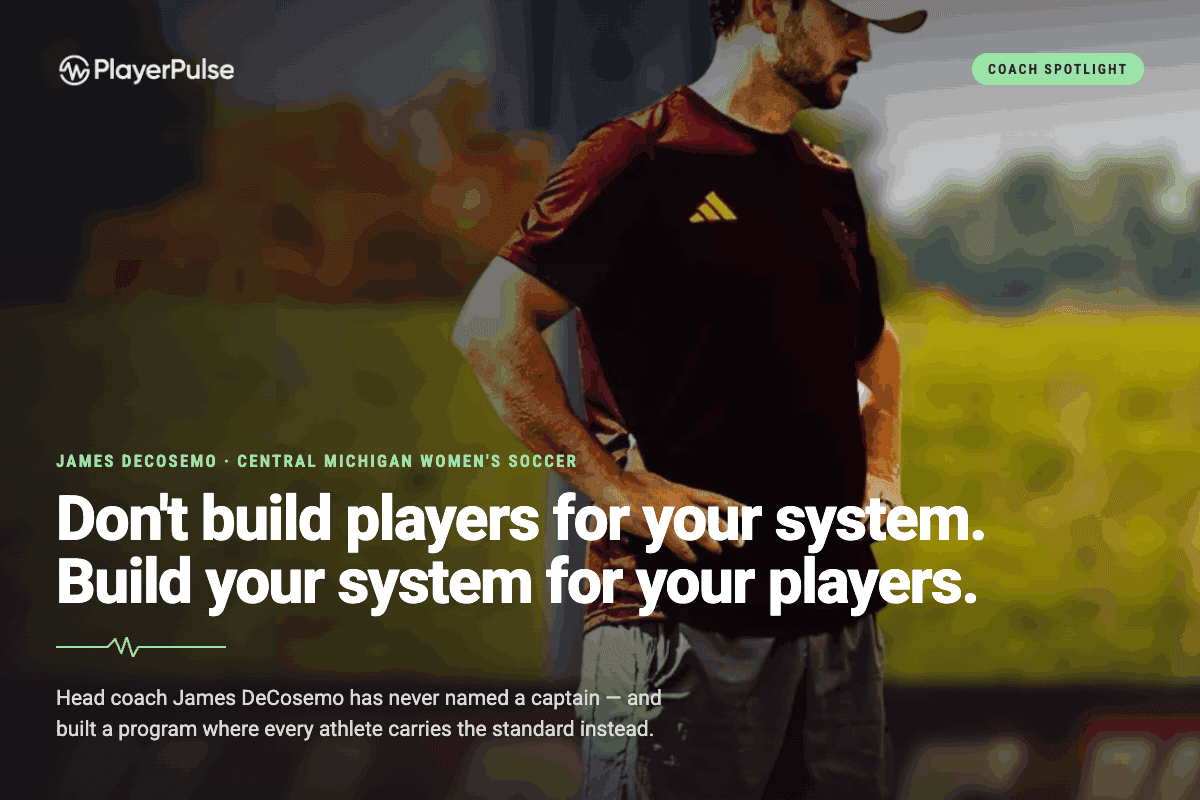
Don't Build Players for Your System. Build Your System for Your Players.
Every preseason arrives with its familiar rituals. New players move onto campus, fitness tests begin, coaches finalize lineups, and somewhere along the way, almost without anyone questioning it, captains are announced.
At Central Michigan, Head Women's Soccer Coach James DeCosemo chose not to. Rather than asking which athletes deserved to be recognized as leaders, he found himself asking a different question altogether: What kind of environment allows every athlete to discover the leader within herself?
Whether we were talking about leadership, tactics, accountability, recovery, communication, or sports performance technology, every answer eventually circled back to the same underlying philosophy. DeCosemo believes the responsibility of a coach is to build systems that help people become more fully themselves, a philosophy reflected in every corner of his program, including the way it approaches sports performance.
In assigning leadership to only a handful of athletes, it carries an unintended consequence. Even if no one ever says it aloud, everyone else begins to understand that leadership belongs somewhere else. Responsibility becomes concentrated instead of shared, and athletes who might otherwise have discovered their own voice can quietly settle into supporting roles they never consciously chose.
DeCosemo has built instead, a culture where every player understands that she carries responsibility for the standards of the team, where leadership is practiced through everyday decisions rather than represented by a title, and where athletes learn to trust their own judgment instead of waiting for permission to contribute. DeCosemo’s coaching philosophy and the culture it creates have translated into remarkable success, including five Wolverine-Hoosier Athletic Conference championships and three consecutive NAIA Tournament appearances, and a 55-5-7 overall record.
The absence of captains has created a culture with genuine camaraderie because players rely on one another and no single individual has been elevated above the rest. The result is a culture where ownership naturally spreads throughout the locker room instead of flowing from the top down. For example, an issue surfaced that required honest conversation within the team. It would have been easy for an appointed captain to gather everyone together, or coaches to step in, but neither of those things happened. Instead, a freshman called a players-only meeting and the team worked through the issue together and arrived at a solution in a way that was ultimately much more meaningful.
How this culture shapes everything else, from the way his teams train and recover to the way they communicate with one another and the technology they have chosen to integrate into that process, is hard not to notice.
A System Built Around the Athlete
Most coaches begin constructing a program by deciding how they want the game to look. The tactical identity comes first, recruiting follows, and athletes are ultimately asked to adapt themselves to the system the coaching staff has envisioned. There is nothing inherently wrong with that approach, but DeCosemo starts somewhere entirely different. "We don't play with a set formation," he explained. "We recruit our team first and then determine what best suits the players we have."
The structure evolves around the people entrusted to it, allowing their individual strengths, personalities, and potential to shape the way the team ultimately plays. The approach asks coaches to believe the best answers aren't always drawn on a tactics board before preseason begins. It also explains why introducing PlayerPulse never felt like introducing a new piece of technology. Instead, it felt like giving an existing philosophy another way to be practiced.
Before DeCosemo became a Division I head coach, he experienced sports performance monitoring as a player preparing for the semi-professional level. Initially he questioned whether the information would actually make a meaningful difference but once he did embrace it, his perspective changed, saying that he "I felt better. Stronger. Faster."
What stayed with him as a coach was not simply the data itself, but what the data encouraged him to do. It asked him to become more aware of his own body, to recognize patterns that might otherwise have gone unnoticed, and to approach performance with curiosity instead of assumption.
Years later, after first being introduced to PlayerPulse while serving as an assistant coach, he found himself watching the platform evolve alongside his own coaching career. As he moved into a head coaching role, during which he was named to the 2024 NAIA Women North Region Staff of the Year, the technology matured as well. What impressed DeCosemo most was not how many new features had been added, but how consistently the platform remained committed to the athlete.
"It has been really cool to see the evolution of PlayerPulse since its inception," he said. "The program continues to evolve and level up, which is exactly what we try to make happen for our athletes, and has remained athlete-driven."
Listening to DeCosemo describe his philosophy, I couldn't help thinking about how PlayerPulse came to exist in the first place. Although they arrived there from different directions, James DeCosemo and Matt Danaher ultimately reached many of the same conclusions. James started with coaching and discovered he needed better systems to support athletes. Matt started with the athlete's experience and built a system to support better coaching. Both arrived at the same belief: the best systems are the ones that make athletes more capable of understanding themselves.
For DeCosemo, PlayerPulse has also helped his program “control the controllables,” which in collegiate athletics can range from sleep changes, academic demands, stress levels that rises and falls throughout the semester. Rather than viewing those uncertainties as unavoidable obstacles, DeCosemo sees them as reminders to become even more intentional about the variables that can be influenced.
"There are so many things we can't control as a coach, so this (PlayerPulse) helps us control the controllables."
What it can do is reduce unnecessary uncertainty by helping coaches, athletic trainers, strength coaches, and mental performance staff recognize patterns before fatigue quietly becomes a preventable soft tissue injury. Instead of operating independently, with PlayerPulse, DeCosemo describes how the performance team works from the same understanding of athlete readiness, allowing conversations to happen before problems become setbacks
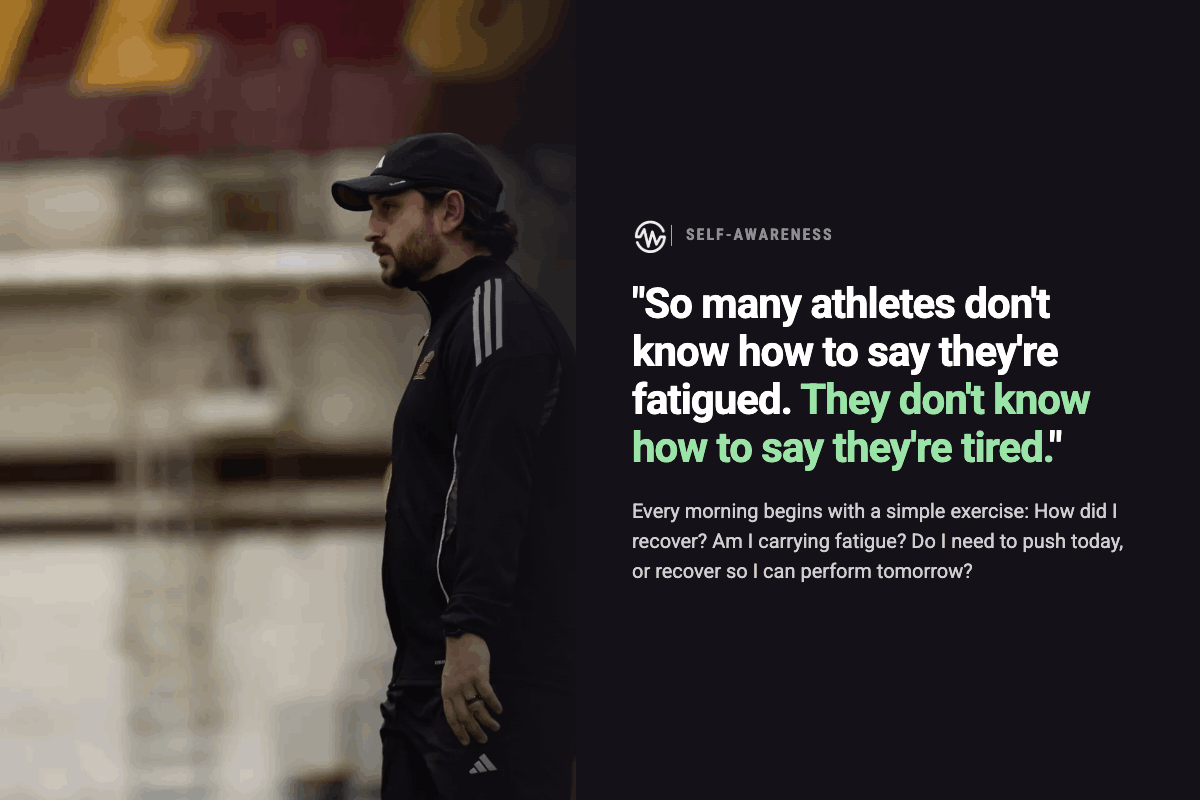
PlayerPulse has also allowed DeCosemo’s coaching to become more personal because it gives athletes a structured opportunity to pause, reflect, and honestly evaluate how they are feeling before stepping onto the training field. "So many athletes don't know how to say they're fatigued," he explained. "They don't know how to say they're tired."
That observation captures something every coach has witnessed. Student-athletes rarely lack commitment. In fact, a large study of NCAA Division I athletes found that athletic identity, commitment to their sport, is deeply embedded in how athletes see themselves. More often, they care so deeply that they convince themselves pushing through exhaustion is a sign of strength. The NCAA's Student-Athlete Health and Wellness Study, which surveyed approximately 23,000 student-athletes across all divisions, shows that athletes continue training – perhaps because they want to impress their coaches, earn more playing time, or avoid disappointing their teammates – even when they are fatigued. Athletes are still uncomfortable discussing those concerns with their coaches. PlayerPulse interrupts that cycle by creating a daily habit of self-reflection.
Every morning begins with a deceptively simple exercise. Before athletes step onto the training field, before they think about earning minutes, proving how tough they are, or living up to someone else's expectations, they pause long enough to ask themselves a few honest questions. How did I recover? Am I carrying fatigue? Do I need to push today, or do I need to recover so I can perform tomorrow?
At first, those questions feel procedural. Over time, they become something much more significant. They become a habit of self-awareness, teaching athletes to recognize the difference between pushing through discomfort and ignoring what their bodies are trying to tell them. The PlayerPulse technology facilitates the conversation, but the lasting impact is that athletes begin having it with themselves.
The check-ins become opportunities to build self-awareness, and over time that awareness gives athletes something far more valuable than another performance metric. It gives them the confidence to advocate for themselves because they have learned to recognize what their own bodies are telling them, replacing the need for external validation with an understanding that the best training decisions often begin with honest self-reflection. Athletes stop their constant demonstration of toughness and begin making decisions that genuinely support their long-term development. They are no longer waiting for someone else to tell them how they feel.
That same principle is reflected in the way accountability is handled within the CMU program. Rather than handing players a list of rules accompanied by predetermined consequences, DeCosemo asks athletes to help create shared agreements that define their respective season. Players decide what commitments they are willing to make, and they participate in determining what fair accountability should look like if those commitments are not honored. Daily PlayerPulse check-ins become one of those shared commitments because athletes understand not only what is expected of them, but why it matters.
The consistency that follows is just as important. Coaches must demonstrate that the information athletes provided from their daily PlayerPulse checkins will never be used against them. Instead, it becomes another way of caring for them, protecting them, and helping them perform at their highest level. Trust grows because actions continually reinforce the promises made at the beginning of the season, and athletes begin to understand that honesty is met with support rather than punishment.
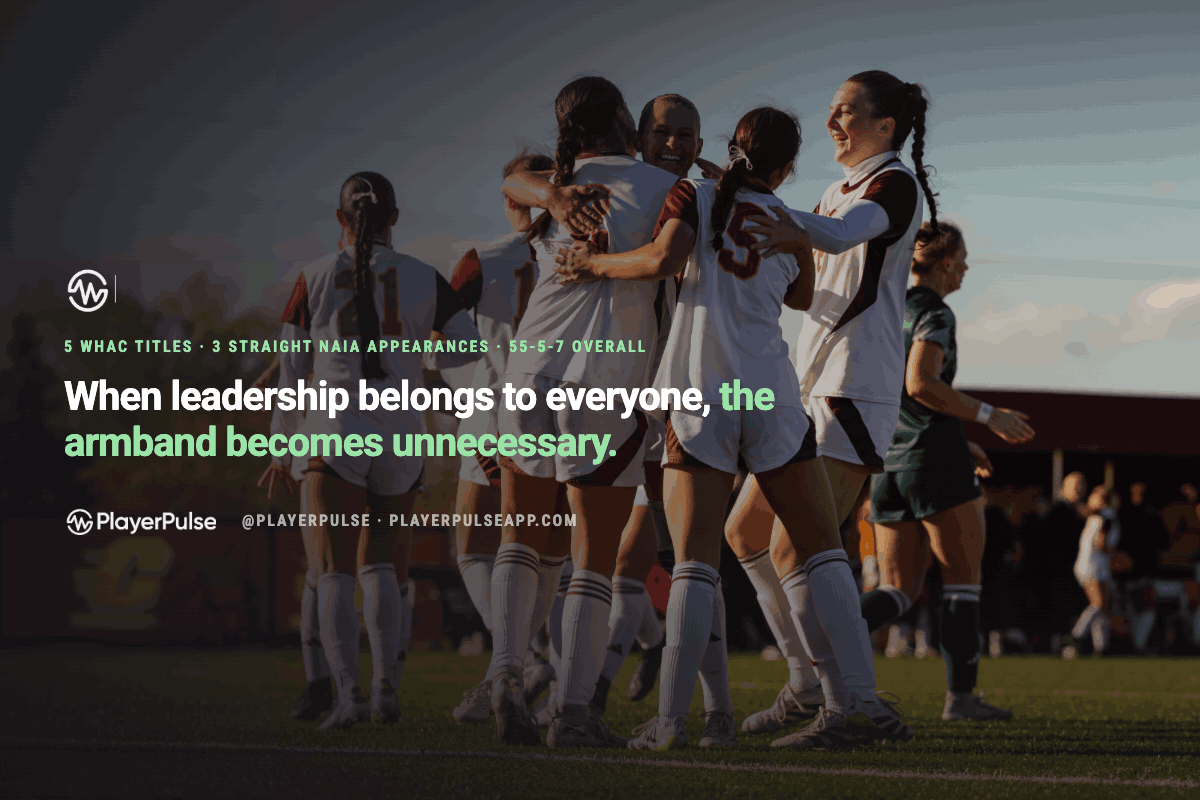
Whereas leadership that’s dependent upon an armband leaves the field whenever that player graduates, leadership that grows from trust, ownership, communication, and the belief that every athlete has something meaningful to contribute, it begins appearing in moments no coach could ever script. It appears when a freshman confidently calls a team meeting because she knows her voice matters.
And with PlayerPulse, it appears when an athlete feels comfortable advocating for recovery instead of pretending she is fine. And it appears when coaches, athletic trainers, strength staff, and mental performance professionals work together because everyone shares the same understanding of what the athlete in front of them needs most.
For coaches with this philosophy, like DeCosemo, it has never been about building athletes capable of fitting perfectly into a system that existed before they arrived. It has always been about building systems thoughtful enough, flexible enough, and human enough to bring out the very best in the people who place their trust in them.
Perhaps that's why James DeCosemo never needed to name captains in the first place. The culture had already begun creating leaders. Perhaps, that is coaching at its best: not asking people to become what your system requires, but having the humility to build a system around the people you have.
When leadership belongs to everyone, the armband becomes unnecessary, because the culture itself becomes the leader. Every athlete leaves the program not simply having become a better player, but having learned to better understand herself.