
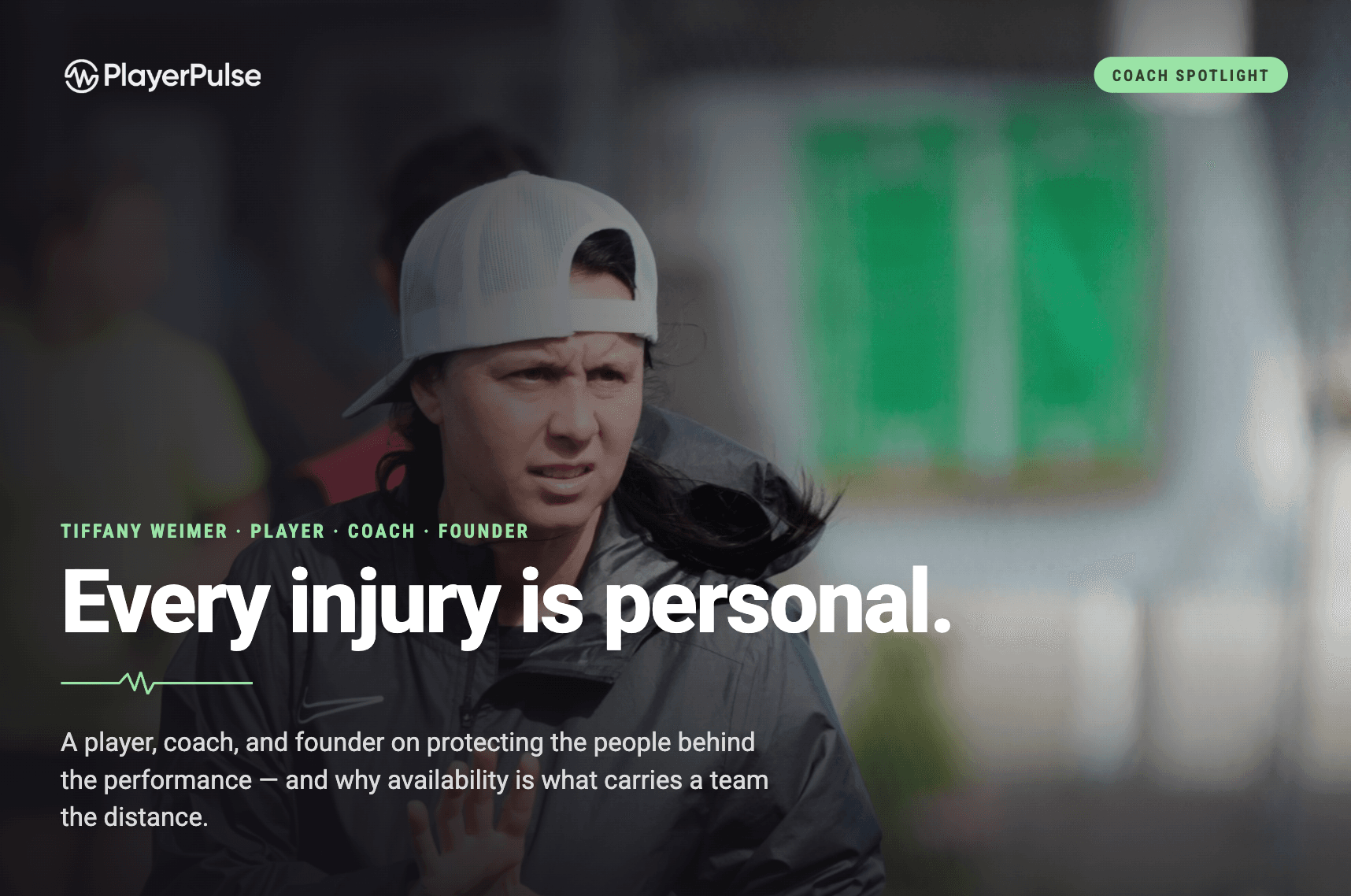
Every Injury Is Personal
Former professional soccer player, current coach, Duktig Brand founder, and longtime PlayerPulse supporter Tiffany Weimer has spent nearly every chapter of her career asking what athletes truly need to thrive. Along the way, she coached alongside PlayerPulse founder Matt Danaher, where they discovered a shared conviction: there was always a better way to support the athletes entrusted to their care.
"Every injury, I take as a blow personally, even though I know I shouldn’t.”
Many coaches talk about injuries in terms of roster availability, missed matches, or seasons interrupted. Tiffany Weimer talks about them differently. For her, every injury represents a person whose development has been interrupted, someone who entrusted part of their journey to her care. By the end of our conversation, it became clear that this way of thinking quietly shaped nearly every decision she makes as a coach.
That perspective was earned over decades in the game. From becoming one of the most accomplished players in Penn State history to competing professionally across North America, Europe, and South America, and now coaching girls and women, Tiffany has experienced soccer from nearly every angle. Over the course of her playing and coaching career, one observation continued to surface: The athletes who experienced the most sustainable success were rarely just the most talented. More often, they were the ones who understood themselves, and they were guided by coaches who took the time to understand them just as deeply.
Those observations didn't just shape the way Tiffany coached, they also helped explain why.
Years after coaching together at the club level, she and PlayerPulse founder Matt Danaher each built organizations rooted in the same fundamental belief: athletes thrive when coaches understand the people behind the performance, and when athletes are given the opportunity to better understand themselves.
For Tiffany, that belief became Duktig Brand, a company designed to help athletes (and coaches) build confidence, resilience, ownership, and self-awareness through guided reflection. Matt approached the same philosophy from the coach's perspective through PlayerPulse, giving coaches greater visibility into athlete wellness, recovery, readiness, and communication so they can make more informed decisions on behalf of the people they lead.
That shared philosophy also explains why PlayerPulse has remained part of Tiffany’s coaching practice for so many years. She doesn't describe it as software or a reporting tool. Instead, she talks about it as something that helps her become a better coach. "The best businesses are the ones that solve a problem," she says. "It doesn't get better than when someone says, 'I couldn't do what I need to do without this.' That's what PlayerPulse does. It makes me a better coach."

For Tiffany, becoming a better coach has never been about collecting more information for the sake of having more information. It has always been about becoming more aware of the people standing in front of her because awareness creates understanding, understanding creates trust, and trust allows coaches to make decisions that truly serve the long-term wellbeing of their athletes. That philosophy becomes most evident in the decisions she makes before injuries ever occur.
Soccer will always include unpredictable collisions, and moments that no amount of strength training and preparation can eliminate. The responsibility, as Tiffany sees it, is not to remove uncertainty from the game. It is to reduce unnecessary risk by understanding as many controllable factors as possible before those moments arrive.
"Even when you train to be strong because when it comes to collisions, we train for that, you can still get hurt," she explains. "We're training for the un-controllables by controlling as many controllables as we can."
Years of coaching have given Tiffany an exceptional instinct for recognizing fatigue, but experience has also taught her that instinct becomes even more powerful when supported by meaningful context. Sleep quality, mood, menstrual cycles, soreness, and overall wellness all contribute to the picture of how an athlete is arriving each day. When nearly ninety athletes are participating in a summer program, those details become impossible to track through observation alone.
"I have a good eye for fatigue," she explains. "But having the tracking from sleep, periods, mood, soreness, it all helps. Because if you're just not aware, that automatically makes you more susceptible."
She often points to goalkeepers because the effects become especially noticeable in their reaction time. Split-second decisions begin taking just a little longer, positioning changes subtly, and movements that once felt instinctive require greater effort. Tiffany points out that the principle extends well beyond one position. Every athlete becomes more vulnerable when fatigue quietly accumulates without anyone recognizing the pattern.
Awareness, however, is only valuable if coaches are willing to act on what it reveals. Information alone doesn't protect athletes. It simply gives coaches the opportunity to make different decisions. Coaches cannot respond to what they cannot see, athletes cannot communicate what they have never been asked to consider, and meaningful prevention begins long before anyone steps onto the training field.
"The hard part is when you have to have someone sit out because you know everyone wants to play," Tiffany says. "Our job is to protect them and make good choices that ultimately help them be better long term.”
Any coach who has worked with competitors knows what comes next. Athletes want another repetition, another practice, another opportunity to contribute because that drive is often what makes them exceptional in the first place. Tiffany just tells them: "You'll thank me later. Trust me. Just trust me."
Trust, however, is never built in that single conversation. It is built through hundreds of moments in which athletes experience their coach making choices that consistently place long-term wellbeing ahead of short-term results. Transparency creates understanding, understanding creates trust, and trust ultimately allows coaches to make difficult decisions without sacrificing the relationship they have worked so hard to build.
For Tiffany, that is where PlayerPulse becomes more than a wellness platform. Instead of asking athletes to simply accept a coach's intuition, both coach and player can recognize the patterns together and arrive at the decision with greater clarity. The conversation shifts from simply telling athletes "no" to helping them understand why today's decision protects tomorrow's opportunity.
Tiffany recently reflected on a podcast [a]in which a coach challenged listeners to stop thinking about players as athletes first and instead begin thinking about them as humans first. That distinction has stayed with her because it captures the standard she continues striving toward each day. Technology is sometimes criticized for creating distance between people, yet her experience has been exactly the opposite. The more thoughtfully she understands her athletes, the more authentically she is able to coach them.
"It's made my relationships with players more human focused," she says. "And it's improved them."
In the end, that may be the most enduring lesson of all. The best coaches are remembered not because they knew everything about the game, but because they never stopped trying to know the people who played it.
By the end of our conversation, Tiffany’s opening words no longer sounded surprising.
Of course every injury feels personal. When you spend your career trying to understand the people behind the performance, it is impossible not to feel responsible for what happens to them. Perhaps that is what separates coaching from instruction.
One teaches the game. The other never stops learning the people who play it.