
Preseason is one of the most hectic times in the season. It's also one of the most important times for building the foundation for success.
Between physicals, learning new teammates, building a game model and implementing a playing style, it can be challenging to make sure you're dosing players with the exact amount of load that they need to build robustness, while also keeping them available.
What are the two most important measures of success in preseason?
- Player Robustness
- Player Availability
Robustness is the ability for players to handle the physical and mental components of a match.
In soccer, this is 90 minutes and usually a 8-10 RPE (rate of perceived exertion). If a player is not able to handle the physical demands of a game because they have not build up a high enough chronic load over the last 28 days, we consider them to be 'unfit' or 'lacking fitness'. This can also manifest itself visually as players being unable to perform high quality actions in the final minutes of a half, or starting to pick up soft tissue, non-contact injuries.
A coaches primary goal in preseason should be to help players build chronic load through training sessions that mimic the physical demands of the league they play in, their style of play, and their game model. This is why it is so difficult to take fitness out of the training session and isolate it, because each team, league and player is different, and the demands of the playing style cannot be replicated in isolated runs.
Players will continue to build their chronic load IF they can stay available.
We define availability as "if you had a match today, could you be selected to play in it because you are not carrying an injury or an illness".
The longer a player stays available, the more robust they will become in terms of their chronic load.
Not only that, but they will continue to learn and understand their teammates, the playing style, and the game model of the team. Injuries and absences are the biggest disruptor of teams in preseason.
You have the best chance of winning when your best team is available and playing together consistently.
Now, in order to keep players available and build their robustness, there are 4 metrics that you need to track in preseason. These are relatively easy to collect, but will make a huge difference as the season progresses.
- Sleep
- Soreness
- RPE
- Training Load Ratio
Let's explore each of these and why they're important
1.) Sleep
When student athletes (or professional players) first return to a new environment, their sleep will almost always be disrupted. This reaction is based in evolutionary principles, where the human body thinks that because they are sleeping in a new environment, there could be danger nearby. It keeps the "fight or flight" mode activated, which disrupts sleep quality and sleep hours until acclimation.
Where this has a big impact is recovery of players, reaction times, and their ability to handle significant overreach beyond their capacity. If a player is not sleeping well, expect them to under-recover, even if they scored high on a fitness test.
2.) Soreness
The jury is still out on how to get RID of soreness most effectively, but soreness in the muscles is an indicator of a few important things.
Soreness is usually higher whenever a new stimulus is added.
For players arriving at preseason for the first time, even if they have been training on their own to prepare, there's nothing quite like the game demands of stop/start, changing direction, jumping, planting, and reacting to game cues.
Soreness can also spike when CHANGING the TYPE of game, such as going from primarily large sided games with less actions per minute, to small sided games with more actions per minute.
As coaches, we want to try to avoid spikes in soreness and also be mindful of UNILATERAL soreness, as this can be a precursor to injury.
Bi-lateral (both sides) is normal and will happen on occasion, but a player reporting soreness in just their left groin or right hamstring is something that should be addressed early by the athletic trainer, before it becomes a full-blown injury.
3.) RPE (rate of perceived exertion)
RPE is one of the best and easiest metrics to collect from players. It essentially asks "how difficult was your breathing during this session". We take the duration of the session (minutes) and multiply it by RPE to find the overall load of the session.
Each player will usually have a different perceived exertion. Sometimes very fit players will report a 7 or 8 consistently, because they are constantly pushing themselves throughout the session, while some may report a 4 or 5 in the same session, but not nearly challenge themselves enough.
Where coaches need to be paying attention is when a player who typically reports a 4 or 5 is actually reporting a 7 or 8, and vice versa. It could be a sign of a player who is overtraining or under recovered, and decisions should be made based on their other collected data and conversations with them.
4.) Training Load Ratio
The last and most critical component is training load ratio.
This is the comparison of acute to chronic load for the player. The sweet spot for this is between a 0.8 and 1.3, as this avoids de-training (losing fitness) while also avoiding those load spikes (greater than 1.3 is considered overtraining, greater than 1.5 is considered an injury risk).
As preseason progresses into the season, we want to continue to push our players safely so that we arrive at the conference playoffs, our team is even fitter then than they were in preseason.
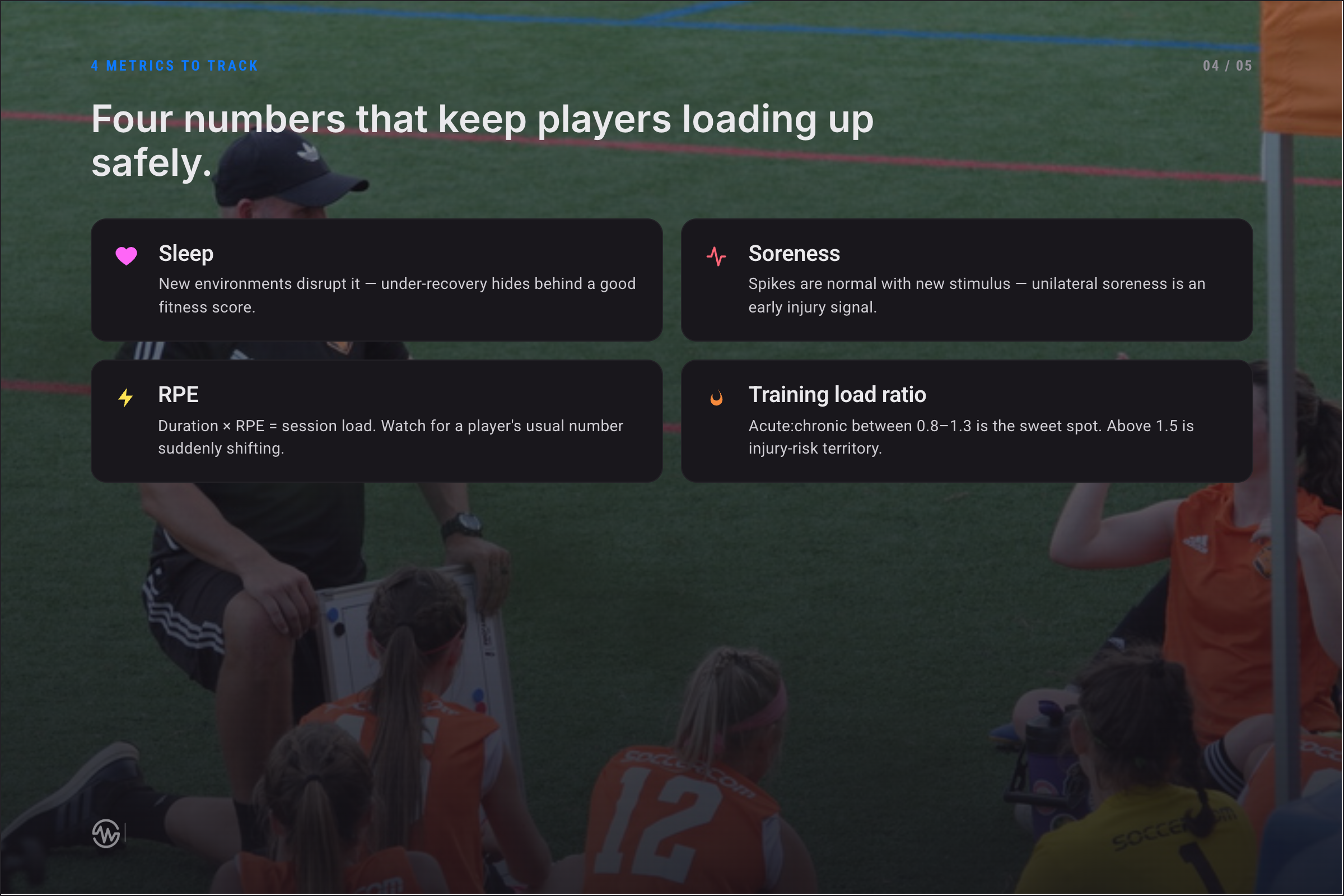
These are the 4 metrics that I have always tracked throughout preseason. If the information above sounds overwhelming, it shouldn't be. I created PlayerPulse specifically to help coaches handle all 4 of these areas, without adding extra work to their plate.
Teams that head into their season with a robust chronic load, minimal injuries, and a high understanding of their playing style are setting themselves up for success in the season and beyond.
The foundation that you set in preseason often decides whether you end the season with a loss, or a championship banner.
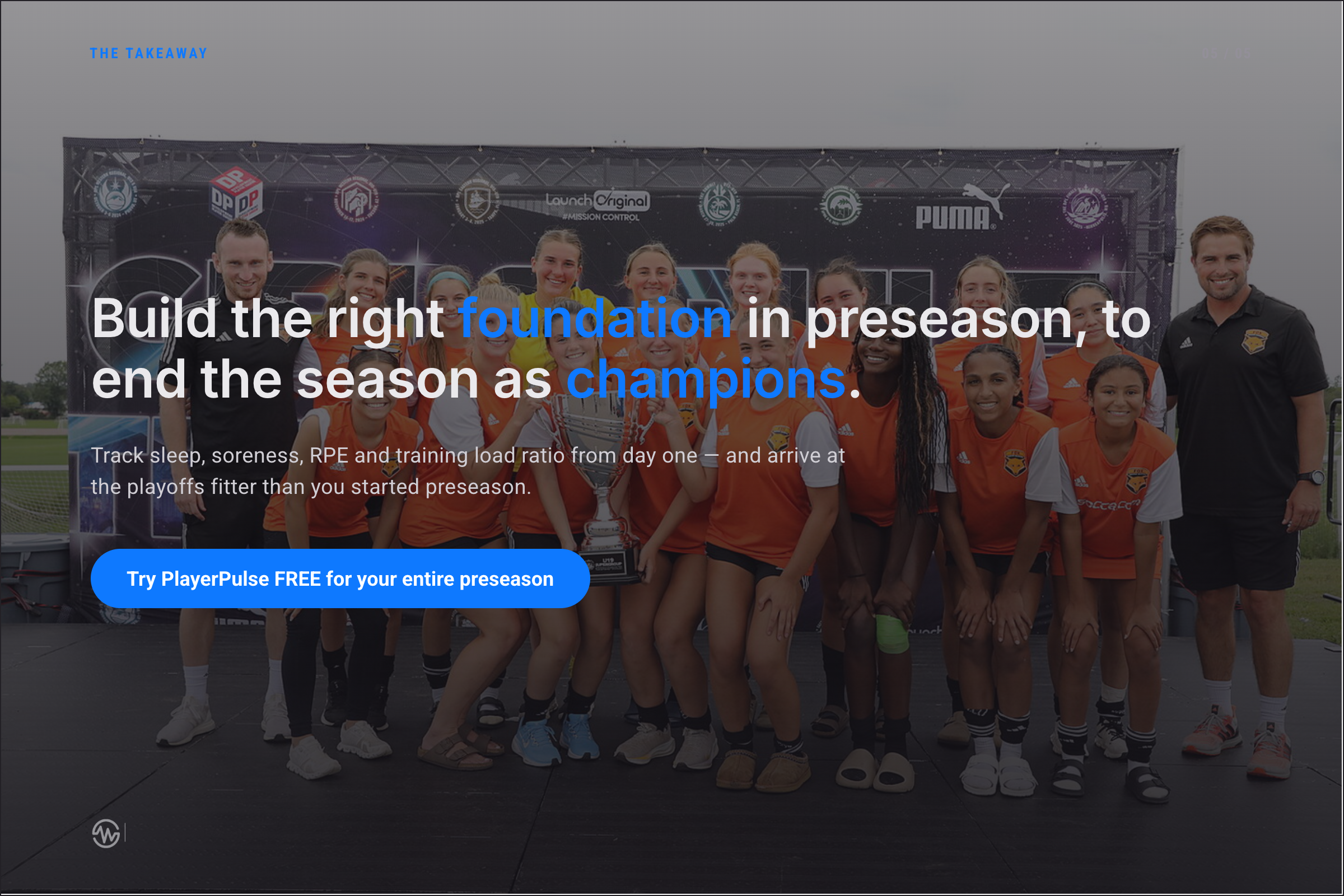
Want to use PlayerPulse FREE for your entire preseason? No CC Required? Sign up for our free trial here and get started immediately