
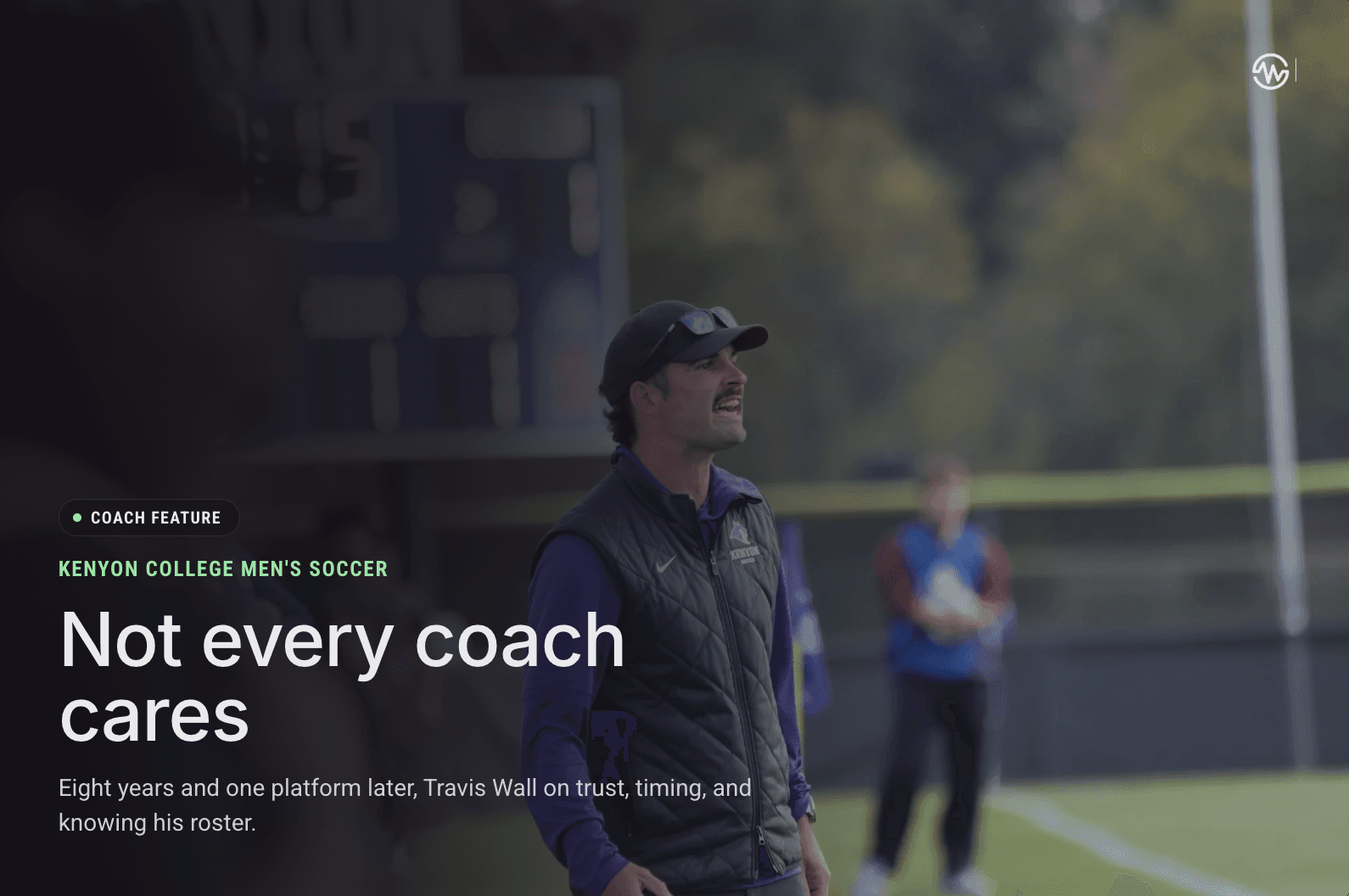
Getting to Kenyon College means driving through rural Ohio, past long stretches of farmland, before the small liberal arts campus comes into view in Gambier, a village of about 2,500 people. Travis Wall, Head Coach for Men's Soccer at Kenyon College was on that same drive, headed back to campus for the first full week of practices, when he talked through what eight years of PlayerPulse has taught him about trust, timing, and knowing his roster.
Most of a coaching staff's year is spent finding the next group of players to represent the program. All of that recruiting runs on the assumption that those players will be healthy and available when it matters. As Wall aptly describes it, it’s not like coaches get more excited hearing a player is dealing with a major injury and out of the selection picture.
Availability isn't a bonus to good coaching. It's the floor on which everything else is built. Walking into his first season at Kenyon College in 2023 after coaching at St. Olaf College, Wall understood this.
He also understood the importance of being relational with his players, talking about more than just soccer, making his guys comfortable around him as a person and a coach. But relationships take time to build, and his players simply didn't know him yet.
Which might not sound like a crack in the foundation, but ultimately it is an availability issue. As Wall points out, without the communication piece that naturally develops with relationships, there is more at stake. "It's a lot easier to hide an injury when you're not constantly being asked."
The First-Year Problem
New coaches inherit a roster of strangers. They may know the players' names, positions and statistics, but they don't yet know what each player will tell them when something is wrong. In the meantime, players are still making daily decisions about how much to share.
Wall built his own grading system early on, something simple enough that it didn't require a long conversation to interpret: a 1 to 10 scale, where anything under 3 meant a player was good to go, and anything over 7 meant it was time to take a break, and that it was OK to push 4-7. But keeping up with that for every single player, every single day takes a toll.
Now using an upgraded systematic approach with PlayerPulse, he says "It's just such an easy way to get the really important information without a long song and dance about how or why, or making them uncomfortable about not being able to play."
That system has since shaped how he builds out practice around what his players actually need, not what he assumes they need based on a roster sheet.
Building the Day Around the Data
Wall's staff pushes readiness reports to players in the morning, with a request to have them completed by noon. Practice planning happens around 1pm, which gives the training staff a window to see anyone who needs treatment before training begins at 5pm.
When Wall first started using the platform, he requested reports first thing in the morning, before players had even gotten out of bed. The problem was the gap between that data and the actual training session. If a team doesn't train for another eight hours, that's a long time for a body to change. The first few hours after a hard training session look completely different from a full day removed from it. He was getting useful information, but not necessarily the information he needed to plan that day's practice.
The team was formerly dealing with a high number of injuries too, and working to improve overall training load. Each year since, both the team’s fitness and its overall health have improved.
That progression has changed what he looks for in the daily report. Part of why nearly a full roster shows up now within the same range on their readiness score now, is because the team is well trained, and because the plan is built around what that morning's data.
Confirmation, Not Discovery
Eight years in, Wall's relationship with the data has changed. What started as a way to close a trust gap with new players has become something closer to a check on his own instincts.
"I use this for confirmation that the workloads are accurate," he says.
He's watched plenty of coaches get excited the first time they get their hands on GPS and wearable data, and he understands the pull, because he used to feel it too. "The way coaches will be really jazzed when they start using a GPS, I get, because I used to use them," Wall says. "Having all that data is exciting. But unless you have the resources and staff to be able to synthesize it, it can only take you so far."
What matters is whether a program has the time and staff to turn those numbers into a call on training. For example, a heart rate monitor is useful, Wall says, but everyone's baseline is different, which is exactly why the player-reported as a quantitative reading .
With 32 players on his roster, Wall can't keep every bump and bruise in his head. Is it an ankle? Is it a hip? What specifically is bothering someone, and where.
Having players report on the specific part of their body that's giving them trouble inside the app means Wall isn't relying on memory or a hallway conversation to know what he's managing on a given day.
He wants affirmation that the training is doing what he designed it to do, rather than assuming a team responds the same way that a different group of guys from previous rosters did, maybe two years earlier.
That discipline extends to how he opens a season. College coaches tend to be routine-based in the first weeks, installing the same attacking and defensive principles practice after practice.
Wall used to come out of the gate heavy with 2v2s and 3v3s. Between what PlayerPulse showed him and the coaching education he's pursued along the way, he's learned that isn't always the smartest way to start a preseason.
He doesn't want players waking up on day two with shot legs before the work has really begun.
What Players Say Before They're Ready to Say It
The piece Wall comes back to is the emotional side. He'd like to believe his players would tell him what's going on with or without PlayerPulse. But especially for a first-year group, before the relationship has had time to develop, players are far more likely to leave those details in a report than bring them up in person.
A comment like "I flunked an exam and I'm struggling" is the kind of thing that might never come up in a hallway conversation with a coach a player barely knows yet.
In the comments, especially around midterms, for example, he’ll get reminders from players that everyone is stressed and that the academic calendar is taking a toll. It is the type of thing a coach knows players are going through but when you see what seems like countless messages all across the board, it puts coaches like Wall more directly in the shoes of their players in their academic world. “It’s a great reminder for me.”
What makes it work, he says, is that the data is both subjective and objective at once. How a player feels on a given day is subjective, but outside of what Wall designs at practice, he's simply reading what a player reports and taking it at face value. He has no influence over the score someone puts down, and it's nuanced enough that he can process it without a second layer of interpretation.
The report itself doesn't fix anything but it certainly simplifies things for Wall. What it does is make a problem visible early enough for Wall to do something about it, whether that's a five-minute check-in after practice or a lighter session the next day.
It also doesn't cost him more of what he has the least to give, which is time. He could build a Google Form that asks the same questions, but he doesn't have the time or resources to dedicate to pouring over 32 forms daily. Being able to see the responses laid out, color-coded by how players are scoring, made the daily read simple in a way a spreadsheet full of raw answers never would have been.
"That's really rare, you know, to find something that meaningfully shapes how you schedule practice and communicate with your team, without asking for a bigger investment of your time."
Giving Players a Say
Just in the past two weeks, Wall held his first team meeting. He opened the season telling players that he might tear up a training plan based on what their scores tell him. That's a different message than the one most players expect to hear from a new coach.
"You guys have a direct say in practice," he told them.
When a coach is asking how you feel, mentally and physically, and you know the answer actually shapes what happens at 1pm, it is empowering. It changes the relationship between a player and the person running the program.
Wall laughs saying that at some point in the season he will inevitably have to remind his players "Not every coach cares to ask how you feel every single day."
Before digital tools made questions like these part of an athlete's daily routine, there was no easy way for a coach to know what a player might not say out loud. The responsibility was left almost entirely to memory, instinct and whatever a player felt comfortable volunteering.
That is what makes PlayerPulse useful after all these years for Wall. It doesn't make a coach care about how his players are doing, but rather makes it clear that a coach does care, and makes it easier to see what players may not say out loud and act on it before it becomes something bigger.
PlayerPulse isn't a tool for one sport, one level, or one kind of program. But it isn’t for every coach, either. It is for the coaches like Wall; the ones that care.