
PlayerPulse sat down with Head Coach of UNCW’s Women’s Soccer team, Chris Neal, to talk about readiness and availability’s role in his coaching philosophy, and how PlayerPulse supported the team’s success. Check out the story below…
What Happens When You Can't Afford an Overuse Injury?
How UNCW Women's Soccer used athlete readiness data, training discipline, and a philosophy of availability to earn the No. 1 seed in the CAA Championship.
Necessity is the mother of invention. It's also, it turns out, the mother of better coaching.
Chris Neal, Head Coach of University of North Carolina Wilmington Women's Soccer, operates with fewer scholarship resources than many comparable programs. There's no endless bag of scholarship money to replace key players going down to preventable injuries. Every athlete on that roster has to be managed like she matters, because she does. Coach Neal made a choice: build a philosophy around protecting his players, then use PlayerPulse to help put that philosophy into practice.
What That Looks Like in Practice
The results of this approach extend beyond anecdotal observations. Here's what changed between the 2024 and 2025 seasons. The team went from searching for a lineup to owning one, ultimately leading to Coach Neal's UNCW squad earning the No. 1 seed in the CAA Championship.
In 2024, the roster was in evaluation mode: minutes spread across a wide rotation, experimentation in the starting lineup that featured six to seven freshmen, and inconsistency in substitution patterns. That's normal for a program still figuring out its identity. By 2025, something had shifted.
The same core players were starting week after week. The defensive unit stayed intact. Goalkeeper Morgan Hobbs anchored the back line with consolidated minutes and organizational continuity. Players like Macy Lutz, Alyssa Chuderewicz, Rachel Fry, and Ava Chuderewicz weren't just contributing; they were playing near-full matches with regularity. Coach Neal added that, “The continuity of our back four, and our goalkeeper was critical. They were so durable. We took very good care of them in training and each of them made all-conference or all-tournament.”
The numbers behind the improvement:
- Top-heavy minute concentration: Starters routinely logged 75–90 minutes, and the starting lineup became predictable and stable.
- Fewer mid-match substitutions: Players were conditioned to sustain performance throughout matches, reducing communication breakdowns between units.
- Defensive continuity as the foundation: The highest-minute players were in the back line and spine of the team. Fewer goals conceded meant fewer goals were needed to win.
Coach Neal made readiness data a non-negotiable input in every training decision, every lineup call, and every substitution. Athletes completed readiness check-ins at a 92% rate throughout the season. In describing his prioritization of availability, he pointed to PlayerPulse as being the tangible system that allowed him to best steward the talent of each Seahawk. This coaching philosophy, supported by PlayerPulse, contributed to a stretch in which the Seahawks went undefeated (7 wins, 0 losses, 3 draws). Most notably, not a single player missed a match due to a soft-tissue injury. Despite a semifinal exit, UNCW finished the year with the best single-season win percentage in program history.
The Real Cost of an Overuse Injury
Before we get into what Coach Neal does differently to achieve the stand-out season results, it's worthwhile to quantify the real cost of an athletic scholarship, because a scholarship athlete sidelined by an overuse injury isn't just about medical costs. Here’s how it breaks down:
- Lost competitive output: games missed, momentum disrupted, season records affected
- Career trajectory: for some players, a preventable injury is the last injury of their career
- Postgraduate health: even injuries that you recover from can create long-term effects, with symptoms presenting decades later
- Scholarship value: tuition, room, board, often $30,000–$70,000
That's not a rounding error. That's a program-altering decision hiding inside a training plan. Coaches who view recovery tracking as a "nice to have" may be overlooking one of the most controllable drivers of athlete availability.
The Moneyball Problem
Now here’s where the math gets interesting for coaches like Neal. Many readers may know the Moneyball story. In 2002, the Oakland A's couldn't compete with the Yankees on payroll, so Billy Beane stopped trying to compete the same way. He leaned into data that the rest of the league was dismissing, and built a 20-game winning streak with a fraction of the budget.
Beane's edge wasn't money, it was tapping into information that the other clubs weren't using. PlayerPulse is built on the same premise: the coaches who consistently maximize player availability often gain a competitive advantage over those relying primarily on their intuition. When asked about his approach to recovery and readiness, Coach Neal was direct. He described his approach as grounded in two things: authenticity and ingenuity.
The authenticity piece is simple, according to Coach Neal. “If you genuinely care about your athletes, you don't deprioritize their wellbeing to get more out of them in the short term.”
With fewer scholarships than his competitors, Neal has to be smarter about how he manages the talent he has. He can’t recruit his way out of a bad training week. He has to protect what is in front of him. The fact that he and his staff have personally fundraised to create scholarships for their roster adds another level of investment that simply doesn't align with anything other than prioritizing the long-term sustainability of each athlete. As Coach Neal put it best:
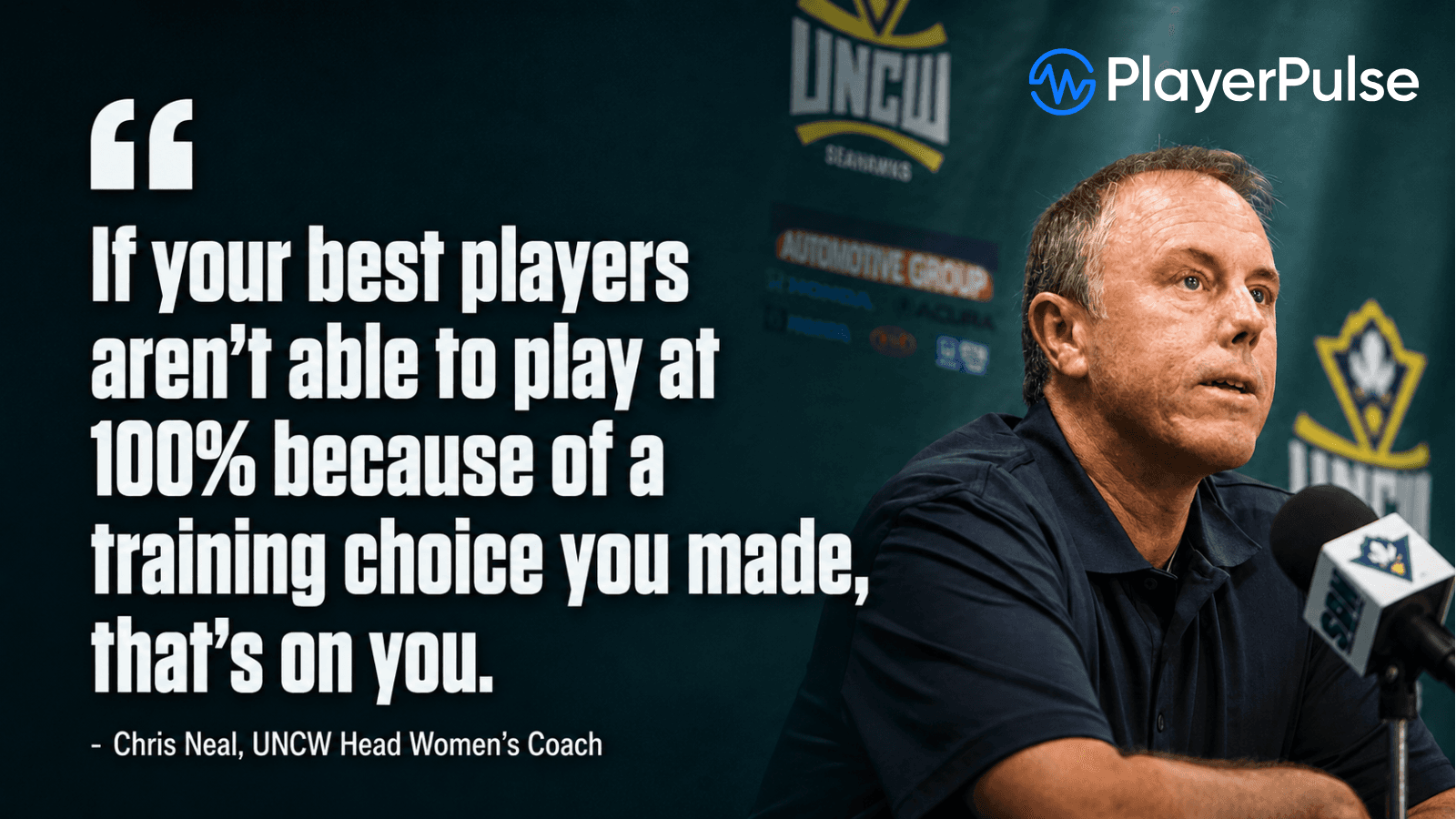
"If your best players aren't able to play at 100% because of a training choice you made, that's on you."
The Staff Rotation Problem
Coach Neal also speaks to how PlayerPulse addresses another layer to player communication that coaches rarely talk about openly. At most universities, sports performance staff and athletic trainers aren't dedicated to one team, they rotate across programs, supporting hundreds of athletes simultaneously. A trainer who worked with your players last Tuesday may not be the same one on the field this week. That kind of turnover creates gaps, and gaps create risk. In fact, in the past 22 years of coaching, Coach Neal shared that he’s worked with a different sports performance professional every single year.
PlayerPulse helps close that gap. When readiness data lives in the platform, institutional knowledge doesn't walk out the door with a rotating staff member. The next trainer, the assistant coach, Coach Neal himself; they’re all working from the same picture. Consistency in athlete management has a single source of truth that every staff member can rely on. That's the Moneyball move, applied to roster health.
What This Tells Us About Every Other Program
Overuse injuries don't discriminate by budget. Fatigue-driven underperformance doesn't check your scholarship numbers before it shows up. Plus, programs with the biggest budgets can miss the smallest things if the systems they use are too complex, or the athletes don’t buy into the endgame. The difference is whether a coach has built the habit of asking "is this athlete ready?" before making decisions, not just "is this athlete available?"
Coaches like Neal and other PlayerPulse users know that those are not the same question. That understanding has a direct correlation to improved odds for winning. The longer your best players remain available, the greater your chances of winning.
** placeholder for “call out text” to repeat these two lines in bold/different font:
Fatigue-driven underperformance doesn't check your scholarship numbers before it shows up. Plus, programs with the biggest budgets can miss the smallest things if the systems they use are too complex, or the athletes don’t buy into the endgame.
The Life Skill: Preventing Burnout
There's one more dimension to the PlayerPulse approach that UNCW’s athletes benefit from, and some coaches tend to undervalue: introspection. When an athlete learns to track her own readiness, to check in with her body, to use that data to advocate for herself, to respect her limits without seeing them as weakness, she's learning something that outlasts her playing career.
Athletes who develop that internal awareness are able to manage stress better, make smarter decisions for the training they do on their own, and know when to push and when to recover. Understanding your body and its limits is a critical component of long-term performance. Coach Neal points out that this upside extends far beyond the season, saying, “You're teaching body literacy, self-advocacy, and sustainable performance. The athlete who learns to respect her limits in college is the professional, in sport or otherwise, who knows how to sustain excellence without burning out.” Coaches who miss the value of sustainability not only limit their winning success but overlook a coachable opportunity to create lifelong success for their athletes.
The Question for Every Coach Reading This
What would your program look like if you treated every overuse injury as something you couldn't afford? Not because you're underfunded, but because you care too much about your athletes, and your results, to let a preventable setback knock a key player out of your lineup?
Coach Neal didn't discover PlayerPulse and then built a philosophy around it. He built a philosophy, and PlayerPulse gave him and his program the information needed to put that philosophy into practice.
If you're already coaching with that mindset, PlayerPulse is the infrastructure you’ve been missing. If you're not coaching that way yet, more programs are beginning to move in that direction. The programs that adapt most effectively will be those that turn athlete readiness data into actionable decisions.
PlayerPulse is the sports performance and risk management platform built for coaches who take athlete readiness seriously.
See what your roster is telling you. Get started at PlayerPulse