
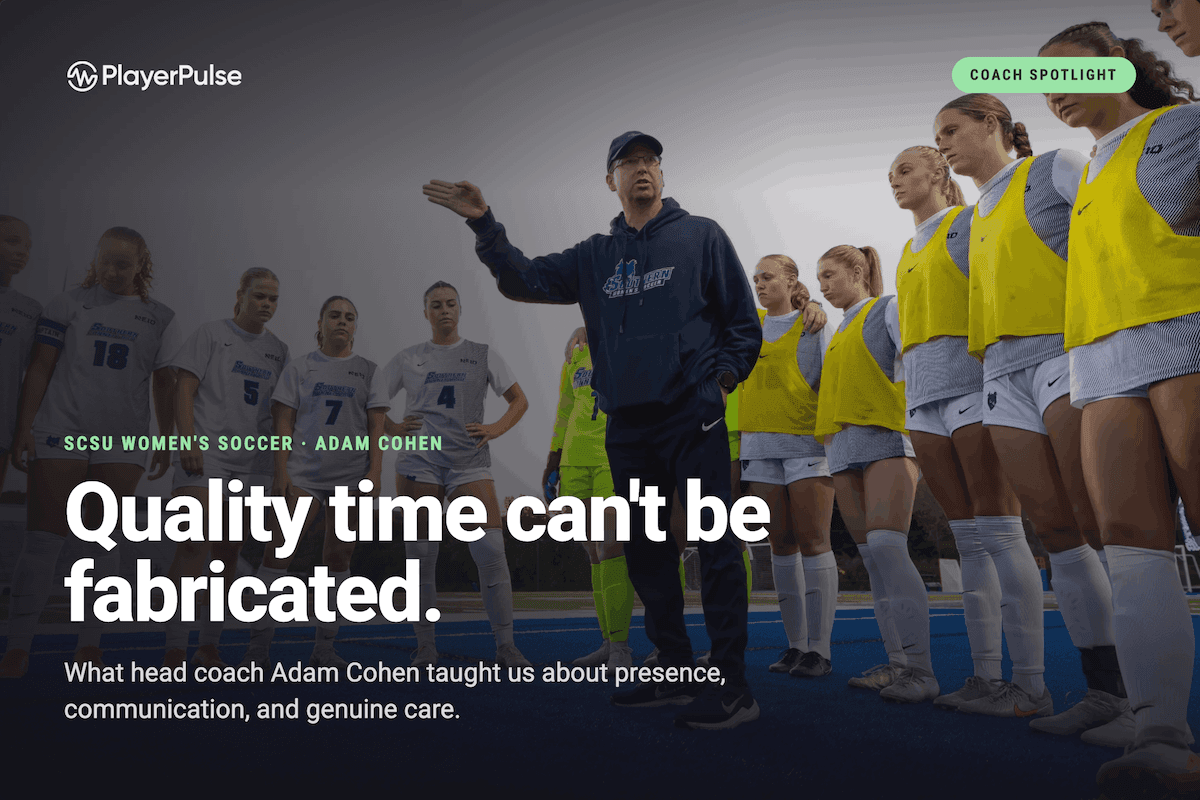
PlayerPulse sat down to learn from the head coach of the women's soccer team at Southern Connecticut State University (SCSU), Adam Cohen. What we uncovered is that quality time can’t be fabricated.
That lesson feels fitting coming from Coach Cohen, whose tenure itself serves as a reminder that some things, like trust, relationships, and experience among them, cannot be rushed or replicated. Here's what we learned about stewarding one of life's briefest and most formative chapters, an athlete's college career, and how coaches can make that experience genuinely meaningful.
An article from a while back comes to mind after diving into a chat about coaching philosophy, the role of sports performance data, and what’s different about coaching today vs 25-years ago. Frank Bruni wrote, “The Myth of Quality Time.” He comes out the gate with a great quote:
“There’s simply no real substitute for physical presence. We delude ourselves when we say otherwise, when we invoke and venerate “quality time,” a shopworn phrase with a debatable promise: that we can plan instances of extraordinary candor, plot episodes of exquisite tenderness, engineer intimacy in an appointed hour.
Coach Cohen captures this sentiment precisely by explaining what is true today in a digital, hyper phone-centric coaching environment, and what was true when athletes were just getting flip phones and still didn’t have unlimited texting. That is the need to have quality, impactful communication. Much like “The Myth of Quality Time” gets after, a coach can’t simply decide “OK, now is the moment” for that to happen.
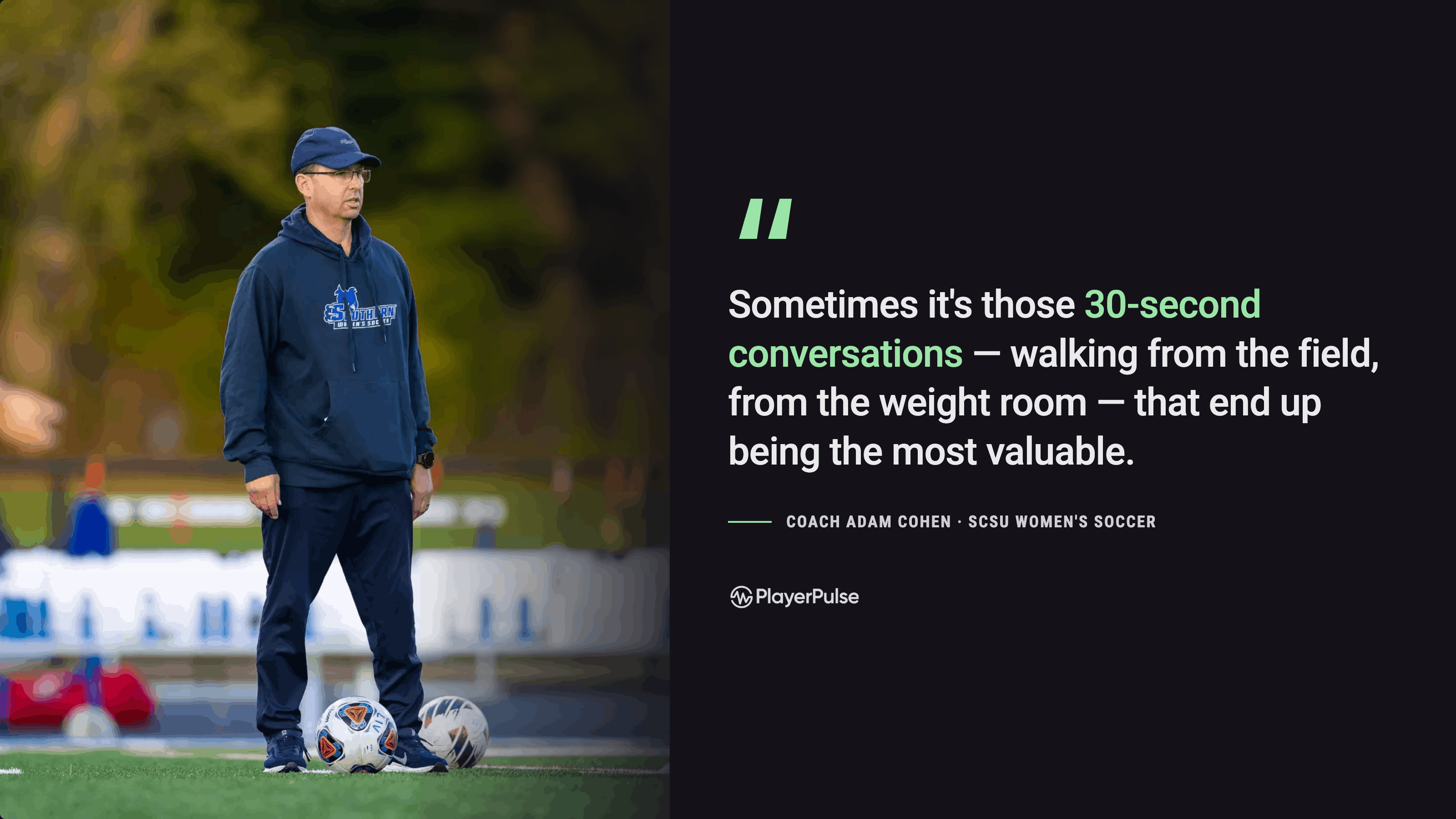
Coach Cohen explains the heart of the matter by sharing, “Sometimes it’s those 30-second conversations, just walking from the field, from the weight room, that ends up being the most valuable. You can’t fabricate that, or even necessarily plan for it even, you just have to make the most opportunities for it to naturally happen.”
Like the quality time myth points out, the trick to having those poignant, authentic moments of understanding comes down to stacking your odds in your favor. “The more communication you have, the more likely that you’re going to have that meaningful moment,” as Coach Cohen puts it. “We are better able to communicate with our athletes because we have just increased our communication touch points exponentially with daily reports. So it’s then an easy way for us as coaches to initiate a conversation by referencing their PlayerPulse data.”
What makes those touchpoints especially valuable is that they create opportunities for coaches to better understand athletes as individuals. Rather than treating an entire roster as a single group moving through the same experience, daily reporting allows the staff to tailor conversations, education, and support around the unique circumstances of each player. As Coach Cohen explains, "Players need to be treated as individuals," a philosophy that extends from training decisions to recovery strategies and the countless conversations that happen in between.
That individualized approach has also helped the coaching staff continue evolving their own craft. Coach Cohen notes that the program previously used a different system that required staff to manually review chronic training load data, a process that often made actionable insights more difficult to uncover. PlayerPulse, by contrast, has streamlined that workflow, allowing coaches to spend less time searching for information and more time acting on it.
As Coach Cohen suggests, “If we are routinely asking athletes to improve, adapt, and embrace better habits, we can also ask ourselves how to be better coaches too. For us, that means using PlayerPulse.”
While Coach Cohen has always believed that sleep, nutrition, hydration, and recovery influence winning, those factors have historically been difficult to quantify with precision. He says that, “Spend enough years around the game and you come to understand that a team's ceiling is rarely determined by the talent listed on a roster and far more often by the availability of that talent throughout the inevitable physical and mental demands of a long season.”
Coach Cohen views wellness information through precisely that lens, not as an end in itself but as a means of creating more opportunities for meaningful communication, earlier intervention, and better-informed decisions around athlete care, all of which increase the likelihood that small concerns are addressed before they become significant setbacks. As he explains, "We've seen decreased injuries. Whether it's groins, ankles, quads, overall health, our players have stayed healthy. Really, we've had very little."
What tools like PlayerPulse do is create more opportunities to notice trends, ask better questions, and address concerns before they evolve into the kind of injuries that keep athletes sidelined. Viewed through that lens, information about sleep, hydration, nutrition, and recovery becomes valuable not because the metrics themselves win games, but because healthy athletes give teams their best chance to realize the potential they already possess.
In many ways, the impact of those small decisions mirrors Coach Cohen's philosophy around communication itself. Just as meaningful conversations are difficult to manufacture but become more likely when coaches create more opportunities for connection, athlete availability is often the result of countless small interventions that, on their own, may seem insignificant but, over the course of a season, begin to compound in meaningful ways.
Players who remain healthy are able to train more consistently, athletes who train consistently continue to develop, and teams with more developed players available when it matters most tend to find themselves in a better position to succeed.
That commitment to athlete wellness is not something that goes unnoticed during the recruiting process either. When asked whether injury prevention and athlete care come up in conversations with prospective families, Coach Cohen doesn't hesitate.
"It absolutely does."
That response is hardly surprising. Parents are entrusting coaches with what is ultimately a brief but formative chapter in their children's lives, one in which they hope their athlete will not only improve as a player, but be cared for as a person.
A track record of keeping athletes healthy certainly helps reinforce that message, and Coach Cohen notes that athlete adoption has followed a similar pattern, with buy-in coming naturally once players see that their feedback leads to better conversations, more individualized coaching, and tangible support. When athletes recognize that communication is resulting in genuine attention to their well-being rather than simply generating more data, the value becomes self-evident and convincing them of it becomes largely unnecessary.
In much the same way that quality time cannot be fabricated, genuine concern for an athlete cannot be manufactured either.