
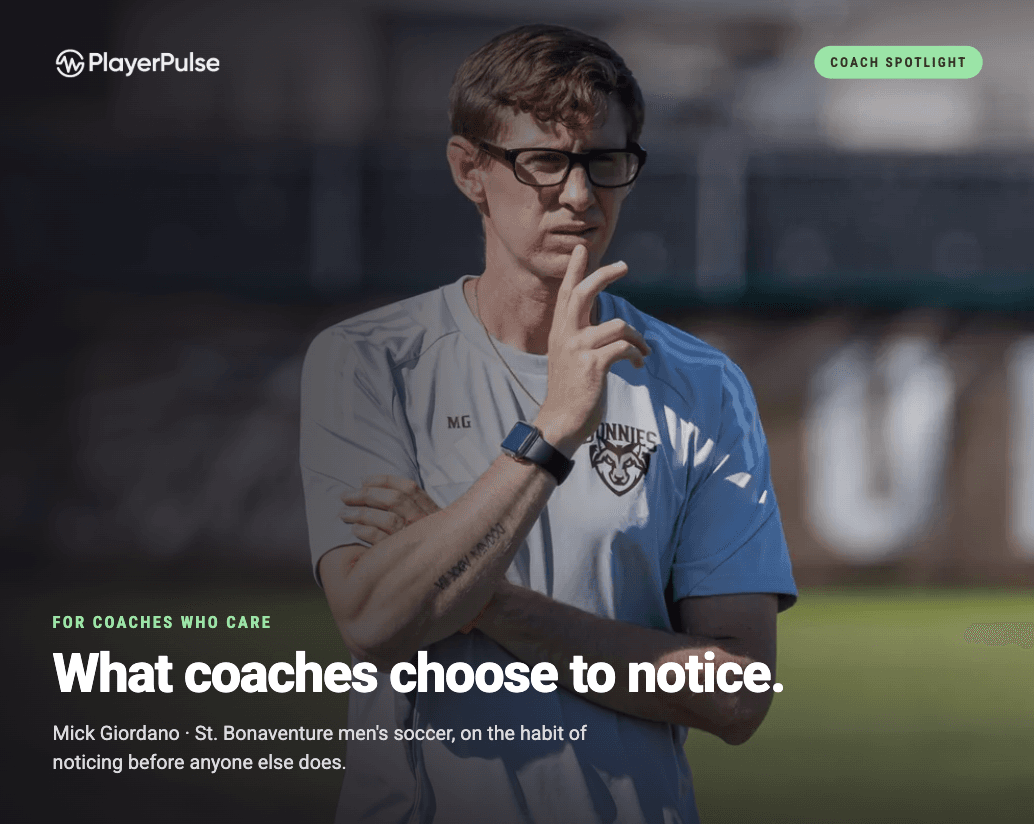
The best coaches don't simply develop better athletes. They develop the habit of noticing. Long before an injury, a conflict, or a performance dip becomes visible to everyone else, they learn to recognize the quiet signals that something, or someone, needs their attention. This is the story of one coach who believes those moments are where coaching truly begins.
"Your best ability is your availability."
It is one of those phrases that has become so familiar it rarely invites much thought. Coaches write it on locker room whiteboards before preseason begins. Strength staffs repeat it after demanding training sessions. Players nod because, on the surface, it feels undeniably true. Talent has little opportunity to influence a match from the training room.
The saying has endured because it contains an obvious truth. Athletes cannot contribute if they are unavailable to compete. But if availability matters so much, whose responsibility is it?
After spending time with St. Bonaventure University men's soccer head coach Mick Giordano, I came away convinced that the familiar saying is incomplete.
For Giordano, availability isn't where the story begins. It's where it ends. Responsibility comes first.
But it is a series of firsts, that all have to work in synchrony. Athletes are responsible for caring for their bodies. Athletic trainers oversee rehabilitation. Strength coaches prepare players for the physical demands of competition. Coaches design training plans that push athletes toward improvement while trying to minimize unnecessary risk.
Ask him where that philosophy comes from and he won't begin with GPS technology, sports science, or the latest advances in athlete monitoring. He begins with his father.
Today, Andy Giordano coaches boys' and girls' varsity soccer at John Paul II Catholic High School in Greenville, North Carolina. Long before Mick became one of Division I soccer's rising young coaches, he spent years watching his father as a coach do something that had little to do with formations or tactics.
He paid attention. Of course, winning, development, and accountability mattered. But beneath each of those priorities was a conviction that would eventually shape his son's entire philosophy of coaching.
"My dad always said, 'The more you care about them as a person and as a player, the more you'll be able to coach them, the more you'll get out of them, and the more they'll understand their why.'"
There is no mention of championships, tactical philosophy, or discussion of performance metrics, or recovery protocols. But by the end of our conversation, it became clear that nearly every coaching decision Giordano makes can be traced back to that one lesson.
That philosophy has carried him through a career that has steadily earned national respect. After playing collegiately at UNC Asheville, Giordano began his coaching career there before continuing his development at Wake Forest and Wofford. He later returned to Asheville as the youngest acting Division I head coach in the country, guiding the Bulldogs through one of the strongest stretches in recent program history, including consecutive Big South Tournament appearances, a conference championship appearance, and a team culture recognized for its academic excellence.
Success only deepened his conviction that there is always more to learn. And the more experience he gained, the more convinced he became that even the most sophisticated training plans cannot replace genuine relationships. Ultimately, Giordano was searching for better ways to answer the question every athlete quietly asks: Do the people leading me genuinely care about me?
That question became impossible to ignore in 2020.
Almost overnight, practices disappeared. The conversations that usually unfolded while crossing campus, taping ankles before training, or lingering after a lift vanished along with them. How do you support athletes you can no longer see?
Around that time, PlayerPulse founder Matt Danaher began hosting webinars for coaches trying to navigate an entirely unfamiliar reality. Giordano logged on expecting to learn more about readiness scores, workload management, and training load. Instead, he found himself refining his approach to the philosophy his Dad taught him.
"What really clicked for us during COVID was understanding the wellness reports," he recalled. "They gave us a gauge of how our athletes were doing holistically as human beings."
The daily wellness reports no longer existed simply to prepare the staff for that afternoon's training session. They had become another way of asking, “How are you doing?” not as an athlete, but as a person.
What the platform changed was his ability to practice that philosophy more consistently, creating intentional moments of connection. Before long, the wellness reports were revealing far more than who was physically prepared to train. They were creating opportunities for conversations that otherwise might never have happened.
"We found massive value in the insights into our players," Giordano said. "And not just how they were playing on the field."
That distinction matters because athletes don’t arrive at practice carrying only the demands of their sport. They bring unfinished assignments, looming exams, family concerns, relationship struggles, financial pressure, uncertainty about the future, and the ordinary weight of becoming an adult.
As Giordano described those unseen burdens, I found myself thinking back to my own years as a Division I athlete. Listening to him, I couldn't help wondering what it might have felt like to play for a coach who asked, “How are you doing?”
For Giordano, that is precisely the point. Better coaching begins with better understanding. And understanding requires creating opportunities for athletes to communicate honestly before their struggles become visible on the field. But that honesty cannot be demanded. It has to be earned.
"The players can absolutely tell they're being viewed in a holistic way (with PlayerPulse)," Giordano told me. "Players know when coaches are sincere."
And when athletes believe someone is truly listening, honesty becomes easier because trust has slowly replaced uncertainty.
"Guys will say, 'I just want you to know there's stuff going on at home.' Just acknowledging that goes a long way."
Sometimes those conversations lasted only a few moments. A player would stop by after training or catch Giordano before practice to say there was something happening at home. There wasn't always a solution. Often, there didn't need to be because the wellness report creates an opening.
Seth Hammond, number ten and a starter in every game of the 2025 season shared that,
“Wellness reports were the first thing I did every single day. I am a big believer in stacking positives and being consistent in every action, and doing them every morning helped get my day started in the right direction. I knew that once I submitted my wellness the day had begun and it was another opportunity to grow as a player and person.”
For the leadership on the coaching staff, that meant instead of waiting until declining performance forces a difficult conversation, it allowed them to notice that something may be wrong before it begins. Giordano describes this all as a part of his learning process as a coach over the years and recognizes he hasn’t “always gotten it right, and I just have tried to learn from failures and continue to grow.”
Sometimes, that simple act of noticing is where caring first becomes visible, and in many ways, that reflects the broader challenge facing coaches today.
Student-athletes have never had more competing demands on their attention in the NIL era. Academic expectations continue to rise. Social pressures follow them long after they leave campus. Families, finances, internships, graduate school, careers, and the ordinary uncertainty of early adulthood all compete for the same emotional bandwidth required to perform at a high level.
None of those realities disappear when an athlete steps onto the training field. The best coaches simply acknowledge that they exist.
"It is hard for anyone to open up about certain things," Giordano said. "This gives them a little bit of protection because they don't have to walk into the coach's office first."
Sometimes the greatest value of a daily check-in isn't the information it provides. It's the conversation it makes possible. Technology, in this case, is not replacing relationships but creating another path toward them. That perspective feels especially relevant for today's student-athletes.

"This generation already has such a relationship with their phones," Giordano said. "This helps us meet them where they are."
For Giordano, awareness always returns to responsibility. Whether that means adjusting a training session, encouraging recovery, or recognizing that today's performance may be shaped by circumstances beyond soccer. That responsibility extends well beyond the players themselves.
"I'll take it one step further," Giordano said. "'Your best ability is your availability' isn't just for our players. It's for our strength coach, our athletic trainer, and us as coaches."
If coaches expect honesty from athletes, they have an obligation to create an environment where honesty leads to better decisions.
"We take it personally if a player has a soft tissue injury," he explained. "If players are being honest, coaches are communicating, and your periodization is right, it might not be perfect, but you're much more likely not to have those things happen."
Giordano never suggests that every injury can be prevented. Soccer will always include awkward landings, unlucky collisions, and moments no amount of preparation can eliminate. Instead, he talks about stewardship. Coaches can't control everything that happens to their athletes, but they can control how they coach. They can control whether they pay attention, whether they keep learning, whether they adapt, and whether they make the best decisions possible with the information they have.
His years at Wake Forest introduced him to an environment where sports science, GPS tracking, workload management, and periodization were simply part of everyday coaching. He’s been dedicated to continuously improving from that foundation.
"I'm not a sports scientist, and I still read the PlayerPulse newsletters because there's always something that can help our team."
When I asked why more coaches have not embraced concepts like readiness monitoring or training-load management, he shared:
"I don't think coaches don't care," he said. "I think they just haven't been exposed to it."
The importance of exposure to new ideas shaped the culture inside St. Bonaventure's program, and perhaps no story illustrates it better than one involving team captain, Kyle Macfarlane.
Last spring, Kyle walked into the coaches' office with an idea. The team had spent months talking about recovery and players understood that sleep, nutrition, hydration, mobility work, and other recovery habits influenced how they trained and performed.
But they hadn’t uncovered a way to make recovery something players owned, and the team still lacked an accountability system for recovery. That is, until Macfarlene exposed them to a recovery program he knew about from his past experience.
“The recovery points system came from experiences I’ve had with different coaches and environments throughout my career. I wanted to create accountability around the small habits that make the biggest difference in performance. Recovery is often overlooked, but things like sleep, nutrition, hydration, mobility, and taking care of your body give you the best chance to perform at your highest level,” shared Macfarlene.
Following any training session or match with a PlayerPulse Rate of Perceived Exertion (RPE) score of six or higher, every player has twelve hours to complete thirty recovery points. Athletes choose from a menu of recovery activities that includes hydration, nutrition, mobility work, yoga, compression therapy, massage, and other restorative practices. Sleep, for example, carries the highest point value because no other recovery strategy has a greater impact on readiness the following day.
Macfarlene adds, “No two players recover the same way, so it was important to build a system that allows each person to take ownership of what works best for their body. Instead of recovery being something that’s simply prescribed by coaches or trainers, it encourages players to be proactive and recognize that the work you do away from training is just as important as what you do on the field. It created a culture where the team takes pride in doing the little things well, and helping each other perform at their best.”
Giordano smiled as he described players sitting in the locker room wearing compression boots while studying for an upcoming exam. I could picture the scene immediately. No speeches, no dramatic team-building exercises. Just college athletes studying for tomorrow's exam while recovering from today's training because, over time, that's what this program has come to value.

When I asked whether PlayerPulse had made a meaningful difference, Giordano paused.
"I don't have hard data," he admitted. "But I know we're being held accountable to monitor recovery, and our athletes know we're looking after them. So I can confidently say it has one hundred percent made a difference."
As our conversation drew to a close, Giordano shared what is most rewarding as a coach. "It is twofold. The first is if your players want to become coaches because they never fell out of love for the game, and it means you kept that love alive."
He paused for a moment before continuing.
"And when they invite you to their weddings, when you get to meet their kids, those are the moments that put everything into perspective."
It is difficult to imagine a more complete definition of legacy. Not championships or conference titles, or wins. Those accomplishments deserve to be celebrated, and they shape careers, open doors, and become part of a program's history. But they were never the measures Giordano returned to most often during our conversation.
Again and again, he returned to relationships, and to the privilege of helping young people navigate one of the most formative seasons of their lives. Soccer simply happened to be the setting where that work took place. The apple it seems, didn’t fall from the tree.
One moment from our conversation stayed with me long after we finished talking.
"It starts with something as simple as talking to a freshman about film or asking about their PlayerPulse readiness report. And then before you know it, that freshman is a senior, and you're bawling at graduation because you know each other like the back of one another's hand."
A coach stops an athlete before training. They spend a few minutes talking about recovery, classes, or something happening away from soccer. Practice begins. The season moves forward. Nothing remarkable appears to have happened.
And yet, coaching careers are rarely remembered because of extraordinary moments alone. More often, they are remembered because of hundreds of ordinary conversations that quietly answer that question every athlete carries with them.
Did someone care enough to notice that there is a person behind the player?
At that moment, I could not have been more proud to be a part of PlayerPulse, to have been a small part of something as profound as landing a “yes.”
Years from now, very few of his players will remember the workload of a Tuesday training session. They won't remember the readiness score they entered before practice.
But they will remember what it felt like to play for a coach who paid attention.
Want to try PlayerPulse risk free this preseason? Start a 30 Day Free Trial (no credit card required) by clicking here.
Not sure PlayerPulse is the best fit yet, but still want to learn more about periodization? Download our free masterclass video on team and individual periodization by clicking here.