
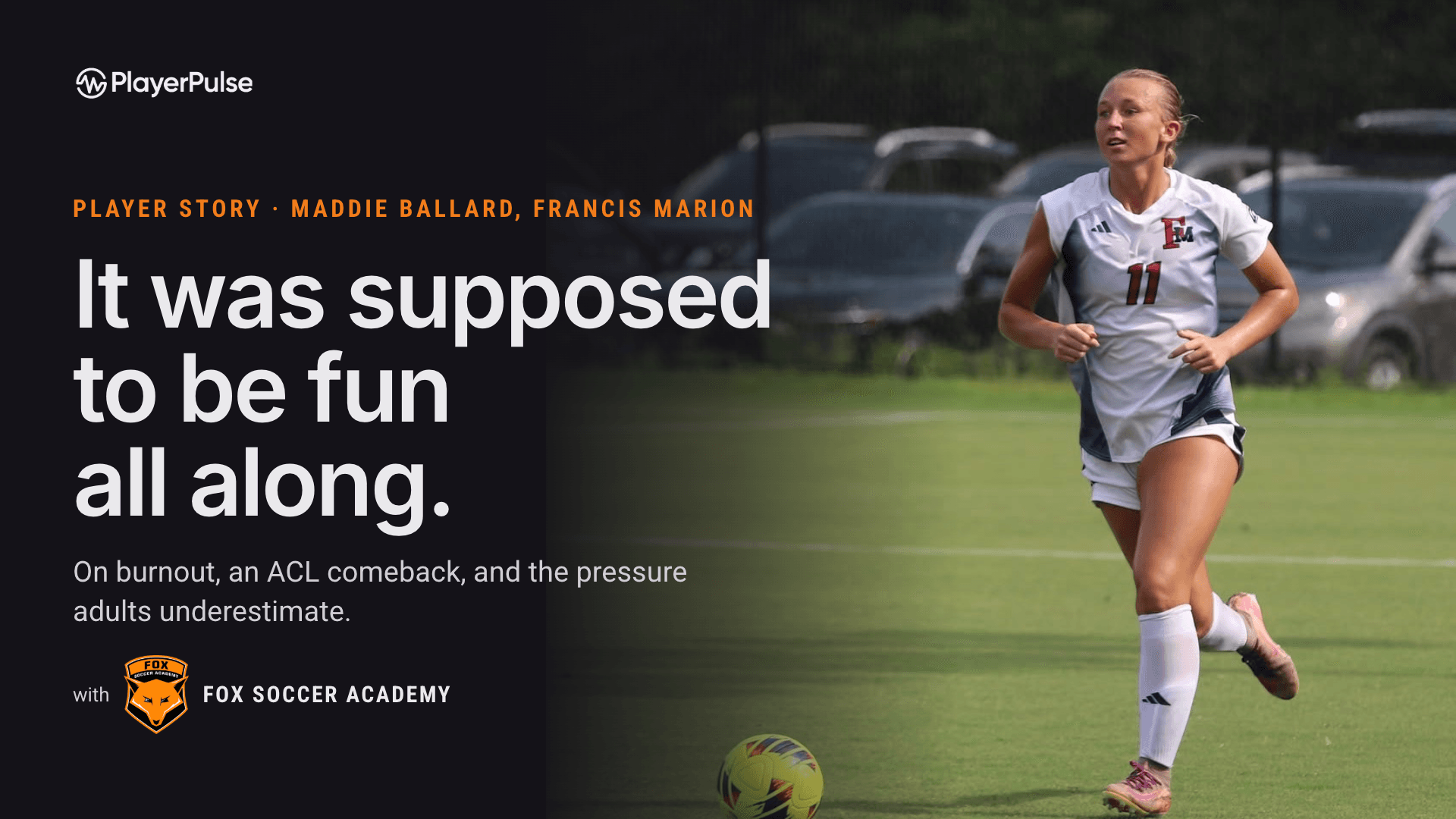
At 2:00 pm on a Friday, Maddie Ballard has a rare gap in her day. She doesn't have a lab on Fridays, so the stretch between her 8:30 a.m. class and two hours of practice at 3:30 is mostly hers. Sometimes she uses it to shoot around for fun, but on this occasion she sat down with PlayerPulse.
Maddie is a sophomore at Francis Marion, and a former player of PlayerPulse Founder, Matt Danaher. We talked about what it's like to be a woman athlete in high school and college, how she has made choices about her athletic and academic career, and what parents and coaches might miss about all of it.
She has played soccer since she was 5 years old and loved it from the start, so pushing herself came naturally. But as she got more serious about the sport, the game became… well… more serious.
The coaches in her early years leaned towards a more punishing philosophy. "You would get yelled at, and I wouldn't say that bothered me, but growing up with that, it made me scared to make even a tiny mistake," she says. "I was so stressed about whether it meant I wouldn't get to play, instead of having fun."
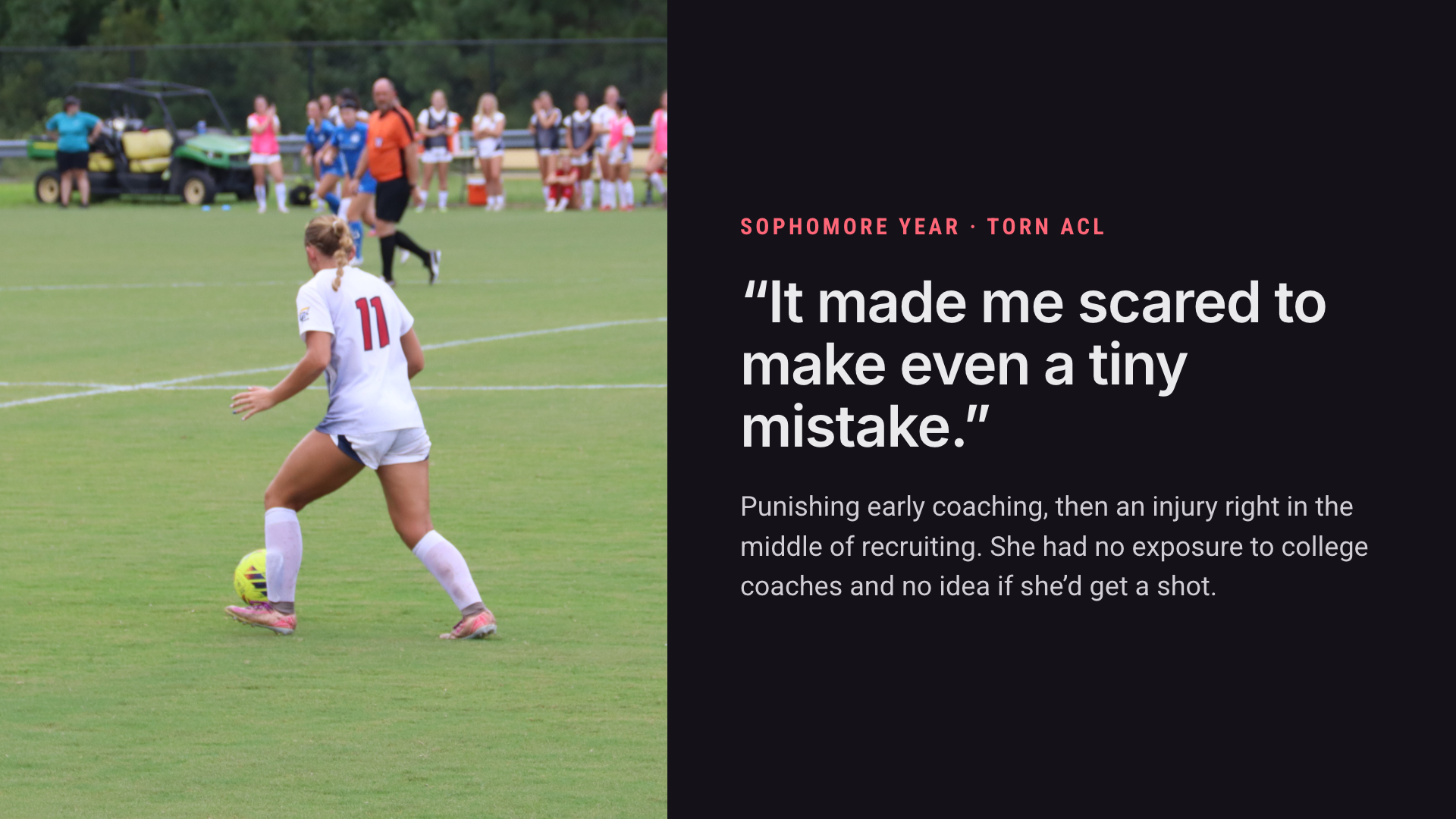
Then in her sophomore year of high school she tore her ACL. "It was a very hard process and also stressful because of the timing for recruitment. Not only was I stressed that I wasn't going to get back to the level I was, but it was always my dream to be a college athlete, so it was very stressful to think about even a year or two into the future. I had no exposure to college coaches at that time, and I had no idea if I was going to have a shot."
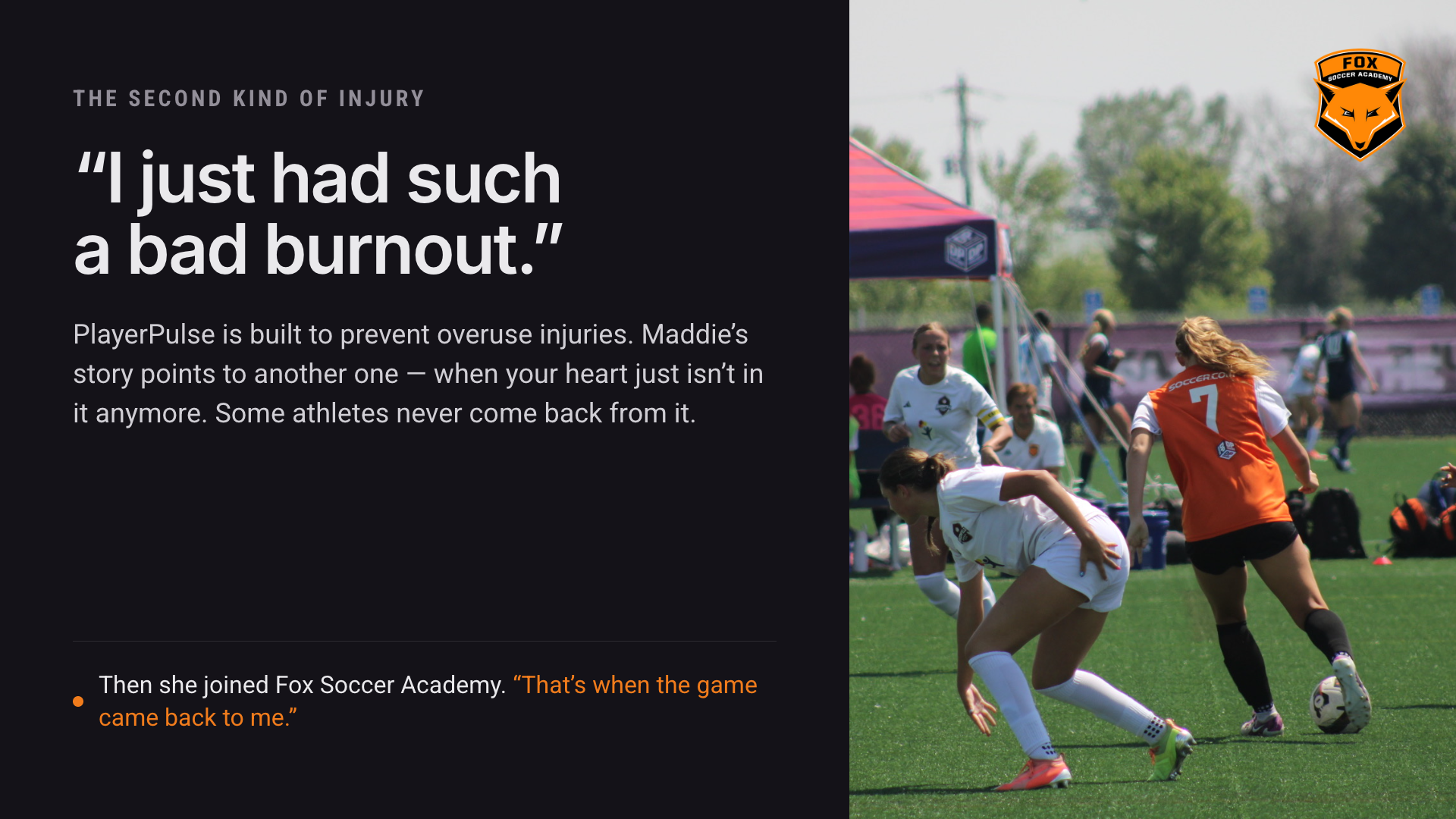
That was then preceded by a difficult coaching dynamic at her club program in junior year that left her less attached to the dream of being a college soccer player. “I was pretty iffy on if I still even wanted to play. I just had such a bad burn out.” But that was right when she found the Fox Soccer Academy, where Danaher, Tipper, and Metzler (Three Fox Soccer Academy coaches) began coaching her. "That's when the game came back to me."
"I was able to start having fun again, to look forward to practices regardless of how well I had done in a game," she says. "I was thankfully able to grow out of the way I was taught. I don't have that 'no mistakes' mentality now, I want to do my best but I am not focused on perfection and now I truly enjoy what I'm doing."
The expectations didn't go away, as Maddie describes Fox Soccer Academy as competitive, and success driven. What changed was that availability came first and the long game mattered at every level. Coaches watched player readiness data, modified training to keep players on the field, and treated burnout as something to prevent.
Maddie talks about specific coaching examples she still remembers, where after a really hard game, they’d take a light practice. “We’d still get on the ball, but we wouldn’t be doing simple sprints. We were still working, but we just didn’t ever feel like unnecessarily being pushed, or punished.”
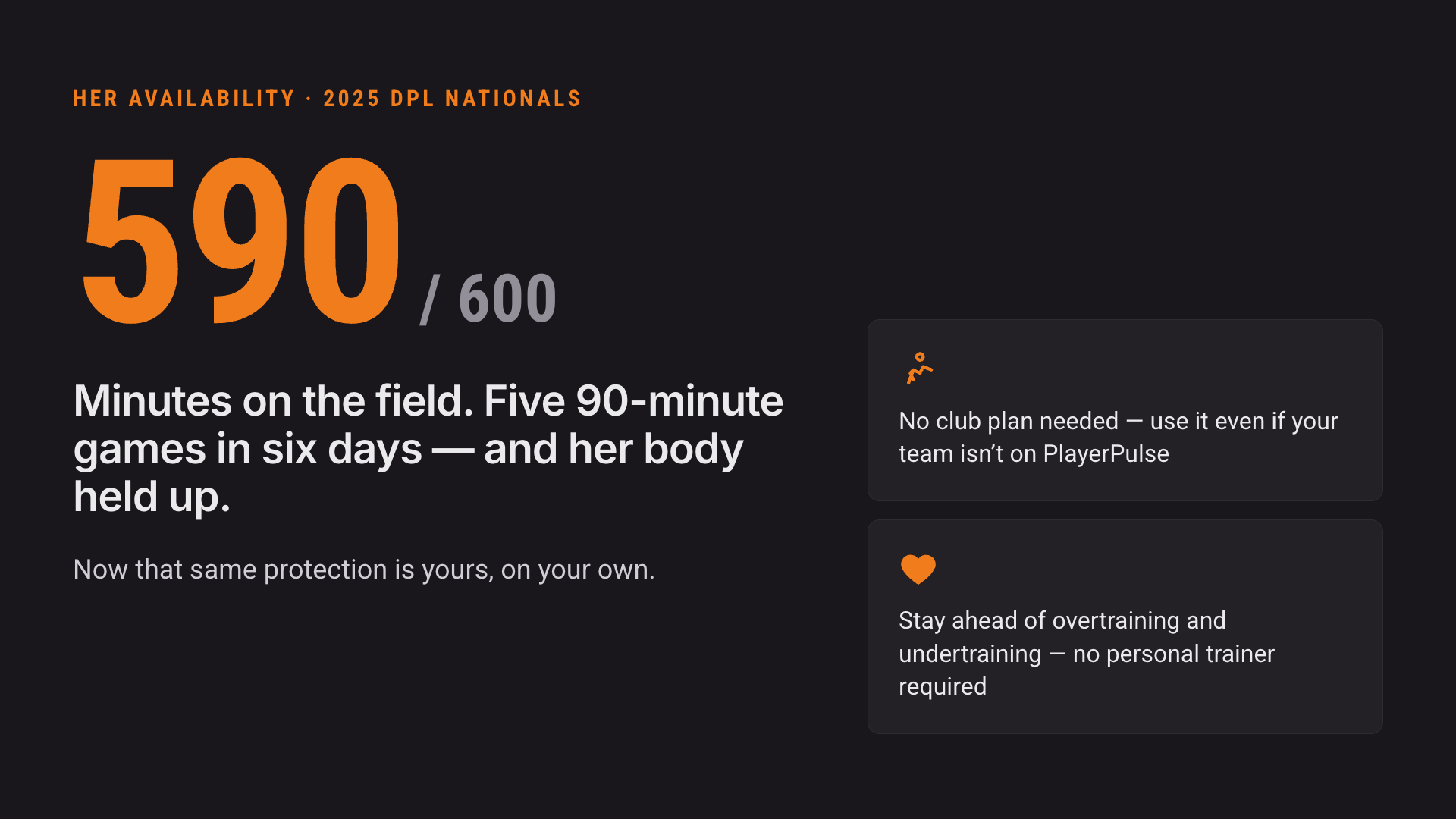
Little moments like that are what added up to a Fox U19 team that won a DPL National Championship in 2025, their first and only season together. To win the event, the U19s had to play five 90 minute games in six days. With the help of PlayerPulse in the 4 week build up to the finals, Fox had every single player available throughout the event, with Ballard playing 590 of a possible 600 minutes.
"Maddie is one of those players that you absolutely love to coach." Danaher says. "I never have to push her to give more. In fact, I have to be very smart about designing sessions where she actually will do less when it’s prescribed. For our U19 team, she was the engine that drove the team forward."
PlayerPulse is built to keep coaches and players from pushing into an overuse injury. Maddie's story points to a second kind of injury, an emotional one, and some athletes never come back from it. It's what happens when your heart just isn't in it anymore.
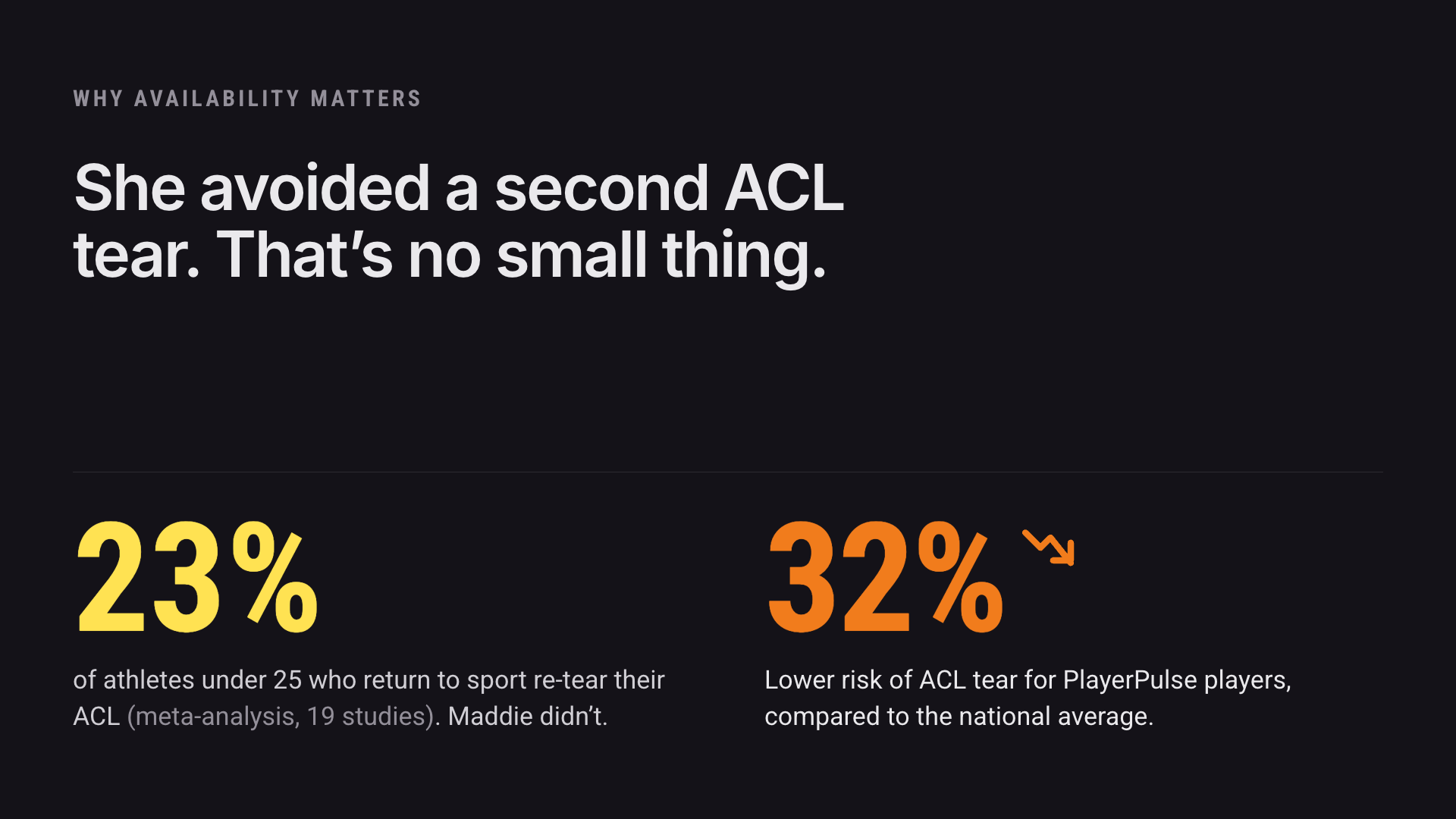
Maddie came back from her ACL tear. With PlayerPulse in place under Fox, she also avoided a second ACL injury, which is no small thing. In a meta-analysis of 19 studies, athletes younger than 25 who returned to sport had a second ACL injury 23 percent of the time. Research on young female athletes has put the figure as high as 32 percent. She got her love of the game back too.
"The shift really did happen because of all of the Fox coaches and Matt, over the summer going into my senior year, and senior year," she says. "Matt knew what we were capable of and just wanted us to put our best foot forward. It helped me get back into the mindset that it was supposed to be fun all along.”
“Maddie was a perfect fit for Fox Soccer Academy.” Executive Director Chad Metzler said.
“She is a competitor at heart, with a true love of the game. Our philosophy is about creating unique environments for players to thrive all while maintaining their love of the game. We believe in player and personal development above team development.”
When coaches talk about their experience with PlayerPulse, this is the part that comes up most, the human side of coaching. Whereas things like readiness data and a systematic approach to availability might be what got them in the door, what keeps PlayerPulse in their coaching year after year is that it helps them communicate and connect with their players in a way that elevates them beyond what they could have achieved before.
Like Taylor Schram, the Stacy Branca '94 Family Head Coach of Women's Soccer at Dartmouth, who says, “Using PlayerPulse is like walking around with your arm around all twenty-eight players. You already know how they're doing before you walk up and ask.”
Maddie also talked about what it's like to be a woman in athletics today. In many ways it's better than in earlier eras, and it still has a way to go, she says. She shares how she didn't learn how common ACL injuries are among women until she tore hers, and how only recently learned that changes across the menstrual cycle can affect sports performance. Either way, it's the kind of thing an athlete should hear about before she's hurt, not after.
Maddie elaborates on her experience as a young female athlete, saying “I would definitely agree that the level of stress and pressure you feel, both in high school and then going on to college, is underestimated by adults," she says.
Coaches using PlayerPulse have confirmed this too, describing how common it is to judge an athlete's stress by what they can see, and most of what they can see is performance. Readiness data and the wellness reports gives a coach a reason to ask before a problem shows up in a game.
In talking about how PlayerPulse has shaped the player that she is today, and what it is like playing with athletes now that haven’t used PlayerPulse, she says that, “I learned I was allowed to have time off and could come back to practice and be completely fine. There wouldn't be any weird looks or punishment. I could just get back to playing. I feel really grateful for that because that isn’t the way a lot of athletes I know.”
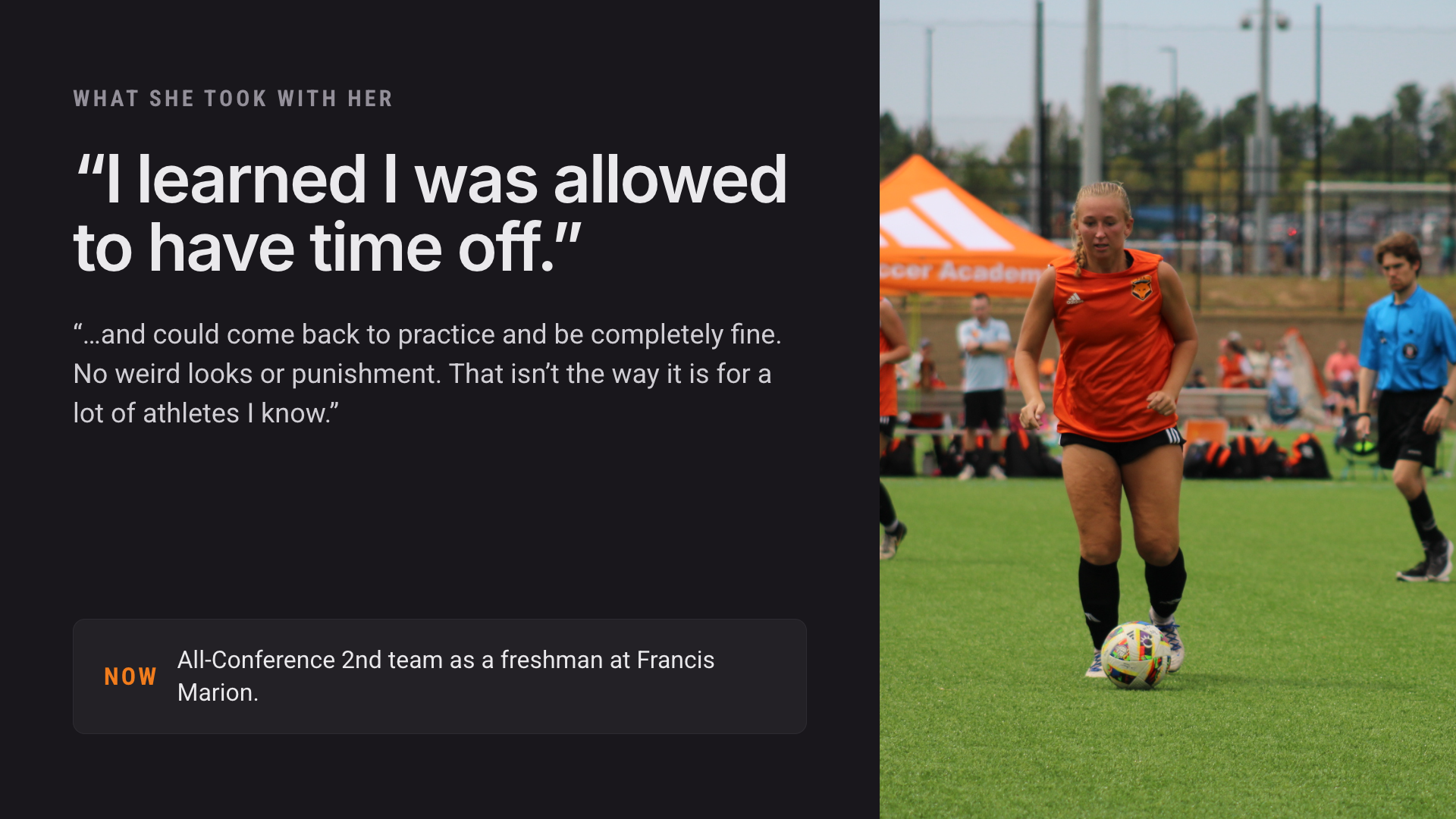
In her freshman season at Francis Marion, Maddie was named All-Conference 2nd team, an incredible achievement for someone who didn’t know where she was going to be playing college soccer just a year before.
In thinking about those players, and how to reach them, PlayerPulse will now offer two ways into its risk prevention mode; through the traditional coach/team enterprise model, and through the new individual “player” version of the app. That also means athletes like Maddie, who have had a past overuse injury and want to avoid another, can use it on their own with the same benefits as the team version.
Asked who the new player version of the PlayerPulse platform is for, Danaher says, "It's for the Maddies out there, players who know how much of a setback an avoidable injury can be. It’s designed to help the player and parent navigate the complexities of overtraining and undertraining, without needing a personal trainer that many don’t have access to."
He adds, "It's also meant for the clubs who want to give their players every avenue to become the best player they can be. The more we invest in the players, the higher their ceiling becomes.” Danaher was a DI athlete who nearly lost his senior year to an overuse injury, so he knows what it costs to miss your sport.
Maddie remembers when she wasn't sure she'd play again. "Now, knowing that I do get to play, having been really unsure if it was ever going to happen, I just enjoy it so much more. It really is so much fun just to get the chance to play. I feel bad for my teammates who haven't gotten to understand yet that the world doesn't end if you make a mistake on the field or have an off game."
Asked whether she'd use the new player version of PlayerPulse, she said it could help keep her ahead of the risk of reinjury. "I really loved everything we did with (the team version) of PlayerPulse, and I think it would be awesome to have that experience again. I feel lucky that I've been feeling good in my body here and haven't felt like I've been pushing past my limits, but it would be good to be sure."
It's easy to overlook how much body awareness Maddie has. After an ACL tear, that matters more than it sounds, because reinjury is common enough that knowing when your body is telling you something is part of staying on the field. She's majoring in biology and thinking about physical therapy, which could put her in a position to help other athletes learn that earlier than she did.
It's now almost 5:30. Practice has wrapped up by now for Maddie, and maybe it is a lift day for the team. Maybe the team is getting together afterwards like they often do, making banana bread or cookies. After all, “You really can have fun and still work hard," Maddie says. "It's about being able to appreciate that you don’t have to be perfect. The fun of it is always being able to just try again."
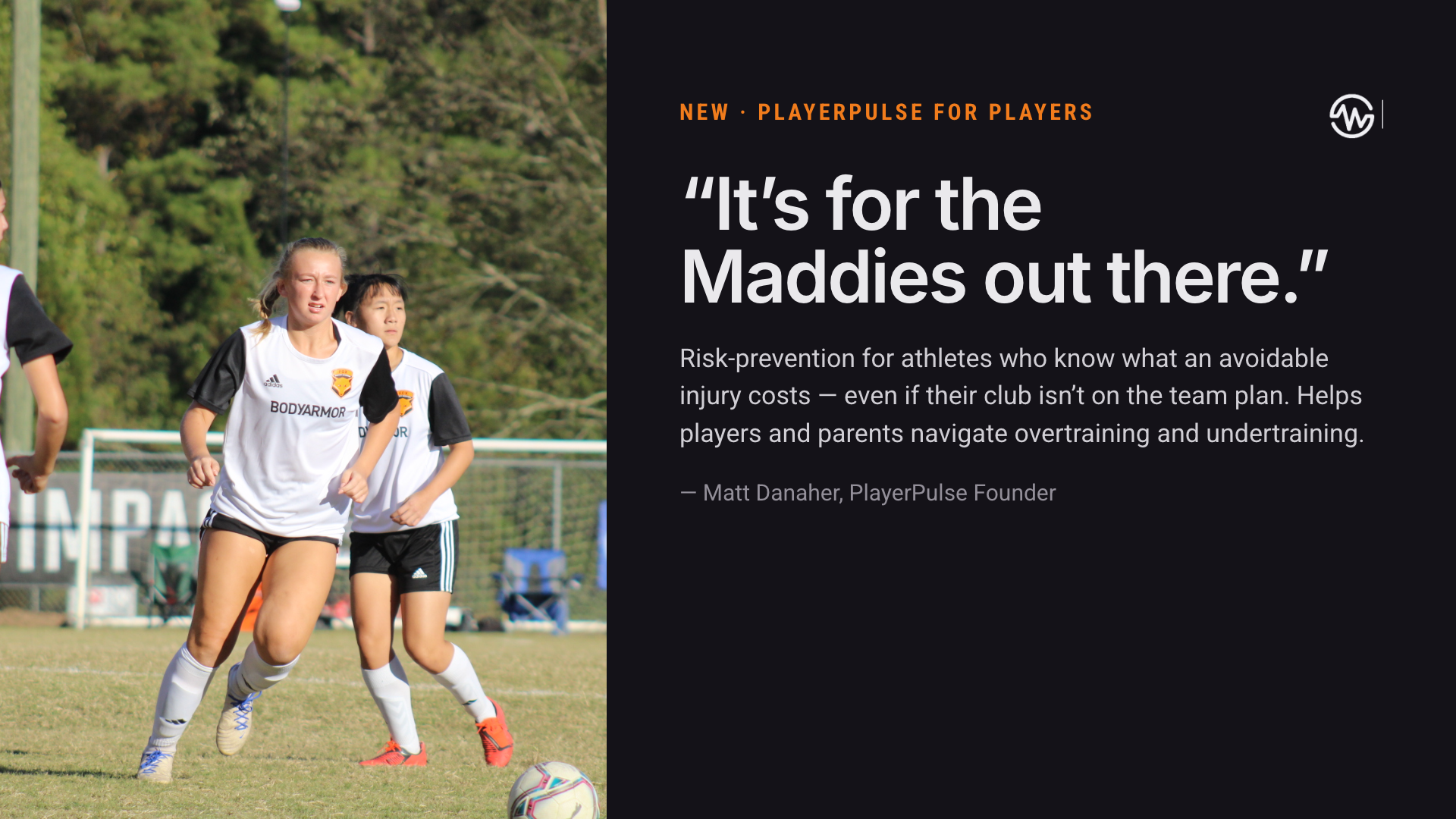
On September 30, the PLAYER SPECIFIC version of PlayerPulse will be available to all players, regardless of team or club affiliation.
Want to be the first to try it?
Register for the waitlist and get early access!