
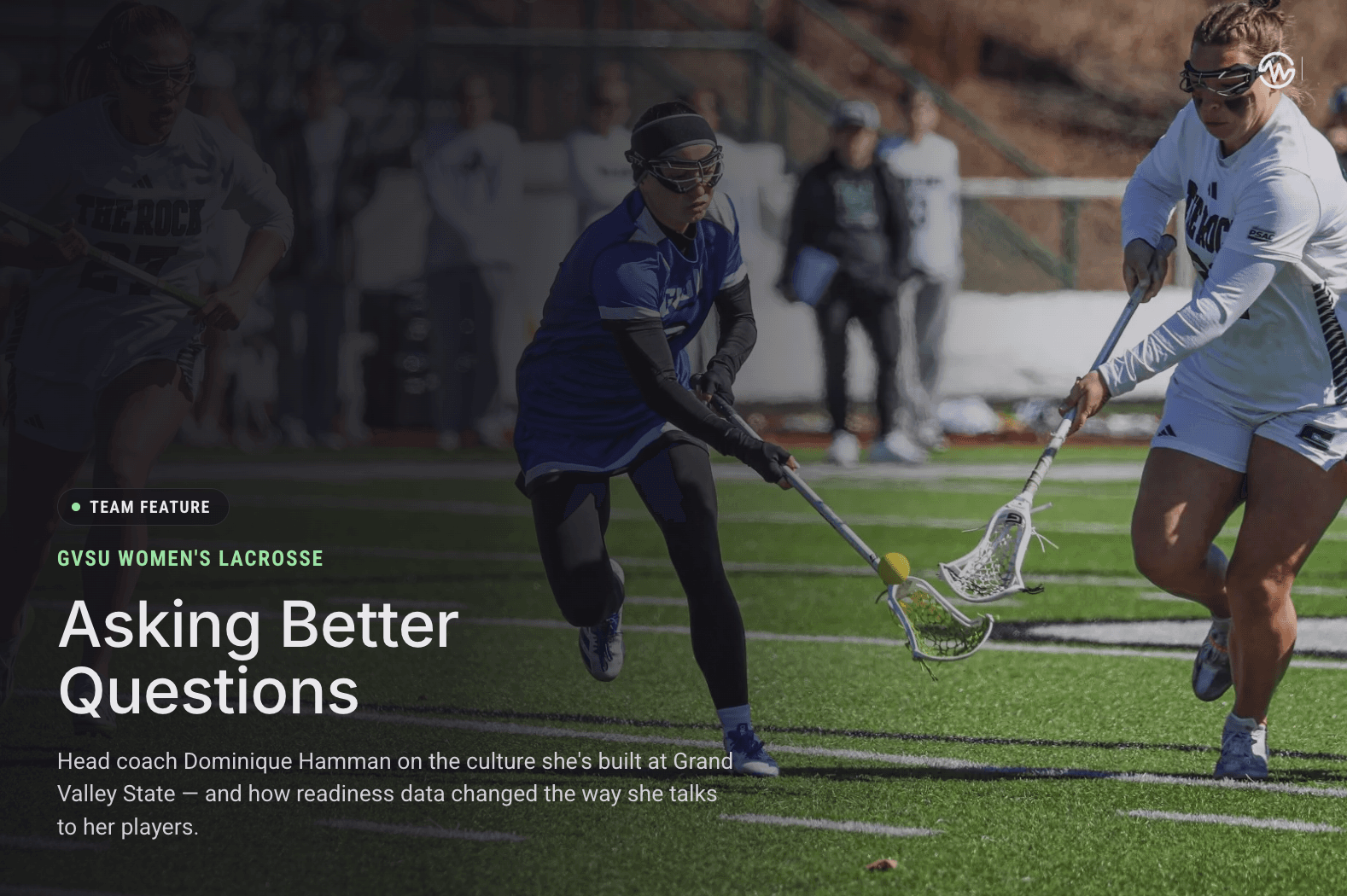
Practice starts between 6:30 and 7 AM, and it's still dark when the first lacrosse players get to the field at Grand Valley State, a D2 program known for winning the Learfield Directors' Cup 18 times. Before the locker room, before the field, head coach Dominique Hamman is already scrolling through that morning's PlayerPulse reports, the wellness check-ins her players filled out the night before, taking an actual pulse on the team before a single drill runs.
The locker room sits right next to the field, and players are usually out twenty minutes early anyway, shooting before anything official begins. Freshmen carry the goals into place. Upperclassmen set the cones. Players are getting dressed, and warming up for the day. Hamman uses that window, warmup, field setup, the walk over from the locker room, to follow up on whatever the reports flagged.
Inside, before anyone steps on grass, the team gathers to watch two or three film clips, just enough to give the day's emphasis a face. Hamman tells them what the drills will be and what intensity to expect. GVSU runs on a high, medium, low system, so players always know which kind of day they're walking into. Music plays through the dynamic warmup, useful for that early hour when energy doesn't come naturally.
From there the team splits. Field players head to the assistant coaches for stick work, dodging into shooting on a high day, more stationary and controlled on a low one. Goalkeepers peel off entirely, running their own series of small drills, banded work, single leg stability, hand eye coordination, built to stay consistent across a week so the reps compound. Midfielders and attackers move through progressions built the same way: specific before general. Twice a week, strength and conditioning follows practice.

When it is all done for the day, the team gathers once more. Sometimes everyone gets to give a kudos and even if time is tight, someone calls out a teammate who did something great. Every day starts and ends together. Hamman built that level of structure for a reason…
Sticks are lighter now, pockets are legal in ways they weren't a decade ago, and Hamman shares the game that has always been fast, now has even stronger athletes, and players come more educated and experienced. "The game has definitely evolved, and it's also become safer," she says. "But we're seeing athletes come to us with more overuse injuries now than ever."
Players often arrive at GVSU having played only lacrosse, year round, since they were kids. No off season in a different sport, no different set of muscles asked to carry the work for a few months. Just the same cutting, the same stick motion, the same explosive first step, over and over, for years. "The specialization of a sport in early years has caused athletes to get burnt out," Hamman says, pointing to the cross training a multi-sport childhood used to provide almost by accident. Their ligaments and tendons absorb the same load in the same pattern for a decade before they even get to campus.
This is consistent with The Aspen Institute's Project Play, which, working with the National ACL Injury Coalition, analyzed years of High School RIO injury-surveillance data and found that girls' lacrosse carries a distinct risk profile. Across girls' sports generally, 57.5% of ACL injuries are non-contact; in lacrosse, that number jumps to 82.5%. The sport's ACL injury rate has climbed 83% over the period studied, more than double the 32.3% rise seen across girls' sports as a whole, and 90.5% of the lacrosse injuries recorded were complete tears.
"This is part of why it just makes sense, at least in lacrosse specifically, to be mindful as a coach that your best talent is probably predisposed to an overuse injury," Hamman says. “That is why you want a system like PlayerPulse to prioritize availability, and to take care of your players,” adds Hamman.
Hamman shares that lacrosse, structurally, is a cutting sport, which makes that specialization especially costly. Hip tightness. Shin splints. The kind of overuse injuries that build quietly over a season instead of announcing itself on one bad play. Her staff leans on PlayerPulse to watch load closely, not just on game days but in the small, repetitive movements that make up most of a practice.

Readiness data from PlayerPulse underneath the schedule shapes which version of a drill a player actually runs on a given morning, and lacrosse lends itself to that kind of individual tracking more naturally than most sports. A draw specialist's body is asked to do something almost nobody else on the field does. A crease attacker absorbs contact in a tiny, scrappy arena the defensive midfields likely won't see. PlayerPulse lets the staff track each class, each set of positions, and individual metrics instead of averaging the whole roster together.
For example, Grand Valley used to run a zone defense, but ultimately it didn't complement their goalkeeper's strengths, such as the angles she read best and shots she tracked fastest. So the coaches switched to man to man defense, which forced a different geometry of shots on goal, shots that played to what she already did well. Her save percentage climbed because the scheme leaned into her strengths.
Hamman's instinct with the goalkeeper was to leave the player alone and change what surrounded her instead, the scheme, the angles, the shape of the defense in front of her. It's the same instinct behind a readiness report with PlayerPulse.
Namely, adjusting the training when the data calls for it because overuse injuries that might start with a tight hip or a sore shin builds in the space between practices. Add that up across weeks of the same cutting motion repeated by an athlete who has been doing nothing but lacrosse since she was a kid, and you can see why the injury rates have stacked so unfavorably.

PlayerPulse gives Hamman the chronic load building over those weeks, not just the soreness reported on a single morning, on a roster where more players than ever arrive already carrying the wear of one sport played year round. "I know PlayerPulse is about a physical thing," Hamman says, "but truthfully it helps more for the humanity aspect of coaching, and that's been really interesting to me."
She continues, adding that. "I may have this preconceived assumption of what's going on," she says, "but what actually is happening is a totally different answer." She's come to see that gap less as a problem to solve than an opening, a reason to ask instead of assume, and something specific to ask about instead of a vague check in.
A check in doesn't have to be about sore legs. Sometimes what a report surfaces is closer to "I'm really stressed out" than "quad soreness, six out of ten." The number gets a coach's attention. The conversation rarely stays on the number.
One player's return from ACL surgery tested exactly that instinct. She'd been cleared by the doctor, passed every physical endurance test, and by every number Hamman's staff tracked, she was ready; strength and conditioning metrics that looked, in Hamman's word, great.
Then one morning, her PlayerPulse soreness numbers ticked up. It was a small enough shift that wouldn’t show up in a strength test. Hamman found the player during dynamic warmups, before practice started. The player told her the knee just felt worn down; not hurt, not reinjured, just not 100 percent. Hamman didn't wait for it to become a bigger problem. Together they reworked the next week: full speed on the things that mattered most, rest built in everywhere else, all of it aimed at one target, a preseason scrimmage the player wanted to enter feeling like herself again.
"I do not think she would have expressed that she wanted to decrease her reps that week if I didn't approach her first," Hamman says. The player brought it up again weeks later, just to say how much it had meant to be heard without having to ask.
That kind of conversation almost never happens mid drill, either. "It's not the easiest to have a conversation," Hamman says of practice itself. "It's quick, and the emotions that are going on are running high." The real value of the data shows up outside the drill, during the twenty minutes before practice while goals are being carried out, the walk between the locker room and the field, the strength and conditioning session afterward.
"As coaches, we're so used to having all the words to say. We do a lot of telling. We might not be the strongest at asking questions, which is where I think there's a lot of benefit from PlayerPulse, because it makes the space for that to happen."
Hamman was just 23 when she took her first head coaching job. She traces her confidence back to being a goalkeeper, a position that forces you to lead with your voice whether you feel ready to or not. Someone has to call the slide. Someone has to run the huddle after a goal gets scored. She sees PlayerPulse creating a version of that same opportunity for every player on her roster, not just the ones wearing a captain's patch or standing in the cage.

Filling out a readiness report is, in its own small way, an act of using your voice, naming what's true instead of pushing through silently, which was her own experience as a player. "I don't remember ever asking," she says of her time at Central Michigan. "Not once." Daily, PlayerPulse creates a low stakes opportunity to develop comfort in naming what's actually going on, and over time fosters confidence.
Sophomore Veronica Ziemer and her teammates are having a different experience. “There are days when my legs are feeling heavy or I may not feel that I am going 100%," she says, "but my coaches already know that, and that provides a bit more ease in managing expectations on any given day." It isn't only a coach-to-player channel, either, she describes teammates checking in on one another too.
“If each team member is considerate of one another’s state of health on a given day, they can adapt to these circumstances and ensure each player feels they have a balance between focus, fun, and productivity on the lacrosse field!”
Listening to Ziemer, the culture Hamman describes her team as having is obvious. “It's like an oath to maintain, based down year over year, how they love on each other." Even under real pressure to perform, the foundation of prioritizing availability leaves room for levity. Players trust each other to support one another, as they trust their coaches to know when to push and when to ease off. That trust shows up in small ways, like a senior pulling a freshman aside after a tough drill. “Nobody on this roster is competing against a teammate for minutes. They're competing to keep improving,” say Hamman.
That trust shows up most clearly in what Hamman refers to as a critical moment in coaching, moments when the qualitative and quantitative data don't quite agree. A player reports feeling genuinely, significantly sore, and she is sore, that part is real. But her chronic load and biometrics tell a slightly different story, one with room left in it, room to push a little further than the soreness rating alone would suggest.
When asked if it is like a liminal moment, a threshold a player is standing on without quite knowing it, Hamman doesn't hesitate. "That's exactly right," she says. "And that is really neat, knowing you're on the precipice of leveling up."
6:30 the next morning, it's dark again, and the field fills the way it usually does. Upperclassmen are already out there with the first ones arriving. In the equipment room, someone pulls a compression sleeve over a hip that's been logging a little extra soreness all week. Hamman already noticed it in that morning's report and is walking over to check in first. In the cage, a goalkeeper is already taking her own footwork reps before the team splits for the day.
GVSU went undefeated in conference play this season, and Hamman won GLIAC Coach of the Year in her second year at the helm. None of it happened because the game slowed down or got any easier on the bodies asked to play it. It happened because a program built around specialized positions, specialized training, and specialized data kept protecting the same handful of muscles asked, morning after morning, to do it all over.