
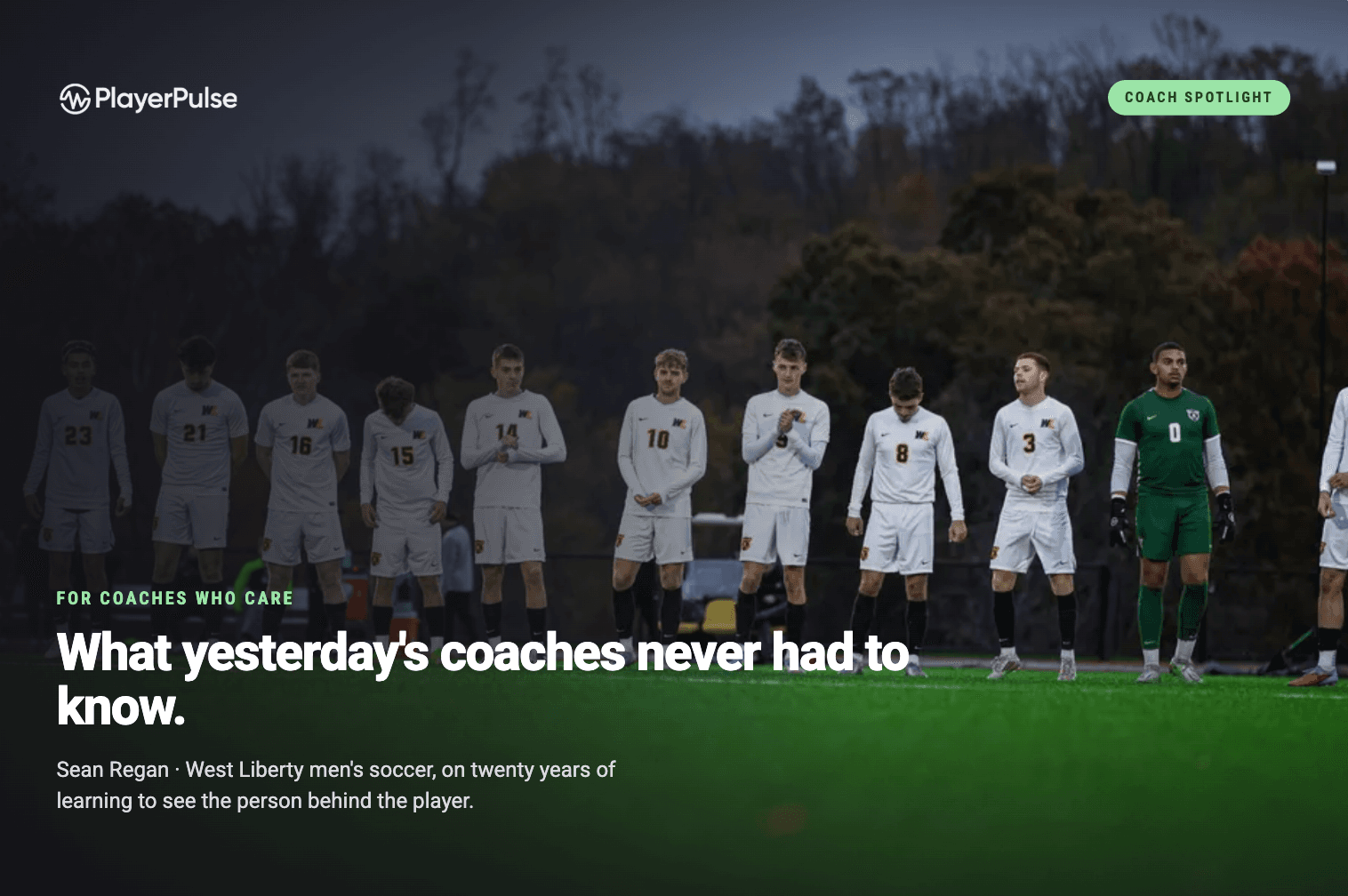
West Liberty’s Men’s Head Coach, Sean Regan, has spent almost twenty years coaching college soccer. Somewhere along the way, his title stayed the same, but the work it described quietly changed.
"Suck it up."
For years, Sean Regan had a simple answer for sore legs, bad days, and whatever else his players carried onto the training field. Looking back now, he laughs.
"I probably used that phrase more than anything."
Few parts of Regan's coaching philosophy have changed more dramatically. Early in his career, he believed every athlete needed to be a little tougher, that discomfort was something to push through and that the field could serve as an escape from whatever happened beyond it.
Experience convinced him otherwise. Coaching, he has learned, isn't simply about changing athletes. It's also about allowing the athletes, and the profession itself, to change the coach.
Every morning, that evolution begins revealing itself by 10 a.m.

Before West Liberty's men's soccer team ever steps onto the training field, thirty-five players complete a brief wellness report that gives Regan, his assistants, athletic trainers, and performance staff an early picture of how the group is doing. Some days the responses simply confirm what everyone already suspected. Often, they reveal something no one would have otherwise known, prompting a conversation before practice rather than a problem weeks later.
If one player reports elevated stress or persistent soreness for several consecutive days, Regan doesn't begin by assuming he knows the answer.
"Hey buddy," he'll ask. "I noticed you're working through something. How can I help?"
Regan credits his evolution in part to the people around him. His father spent nearly four decades coaching at Wheeling Jesuit University. His younger brother has coached across every collegiate level. Between them, soccer has never been merely a profession. It's been an ongoing conversation, one built as much on questioning old assumptions as sharing new ideas.
"We constantly help push each other along to be the best," Regan says, "and help one another with our own personal experiences."
The athletes changed, too.
When Regan entered coaching nearly twenty years ago, most players wanted answers to familiar questions. Had they trained well? Why weren't they starting? What needed to improve before Saturday's match?
"They'd ask, 'Coach, how did I do today?'"
Today's conversations begin somewhere else. Players still want feedback on their performance, but they're just as likely to ask about recovery, nutrition, academic choices, career paths, or the data behind their training. They've grown up expecting information to be immediate, personalized, and available at their fingertips, a shift that has quietly expanded the expectations placed on coaches long before the opening whistle.
"While players come to us for more, I'm able to focus more on the soccer side because we have specialists, from athletic trainers to nutritionists and counselors," Regan says. "At the same time, I'm always available for that life coach moment when they need it."
A modern college athlete rarely develops under the guidance of a single coach. Athletic trainers monitor injuries, strength coaches oversee workload, counselors support mental wellbeing, and nutritionists guide recovery. Keeping each member of that network aligned around the same athlete requires far more than good intentions, and it's one area where Regan believes technology has fundamentally changed the way his program communicates.
"Having the PlayerPulse coaches dashboard with access to our coaches, trainers, and strength coaches, and being able to reference sports counseling, it makes a world of difference," he says. "We quite literally are on the same page."

For all the concern that performance technology would make coaching less personal, Regan has experienced the opposite. Instead, it helps coaches notice what they might otherwise miss, creating opportunities for conversations that begin with curiosity instead of assumption.
Sometimes that conversation isn't with Regan at all. It might happen with an athletic trainer, one of his assistants, or a sports-specific counselor. The point isn't who has it but that it happens, and that the athlete reaches the person best equipped to help.
The biggest change came when Regan stopped expecting athletes to separate the person from the player.
"When I first started coaching," he says, "I probably believed that if something was affecting a player off the field, they needed to leave it at the sideline. The game was supposed to be the escape."
Experience has taught him that athletes don't divide their lives into neat compartments. A difficult exam doesn't disappear because practice starts at three-thirty. Neither does homesickness, a family conflict, a breakup, anxiety, or the uncertainty that comes with trying to figure out who you are while simultaneously competing at a high level.

That doesn't mean coaches have become therapists. It means they've become better at recognizing when something is affecting performance and helping athletes reach the people best equipped to help. At the same time, Regan adds, “I am always available when a player opens up and is looking for you to have that “life coach” coaching moment. That is very special.”
Regan sees those conversations differently than he once did. If a player's wellness reports begin showing elevated stress for several consecutive days, he may check in directly. Other times where the situation calls for it, one of West Liberty's counselors will be asked to reach out instead.
Athletic departments across the country have increasingly integrated mental health professionals into athlete care, reflecting a broader recognition that supporting the person is inseparable from developing the player. Organizations such as The Hidden Opponent have helped accelerate that shift by encouraging athletes to ask for help.
The change has been just as noticeable inside the locker room.
"We have a full-time and a part-time counselor," he says. "That's probably the biggest change since I started coaching, and definitely since COVID."
He believes today's athletes are also becoming more willing to accept that support.
"I think guys seeing things happen at the national level are kicking away that stigma of machismo. Being able to share their emotions actually makes them stronger."
It would be easy to mistake that for evidence that today's athletes are somehow more fragile than previous generations. Regan doesn't.
College athletes aren't unique because relationships affect them more deeply than everyone else. They're unique because they're often experiencing many of life's defining moments for the first time while simultaneously performing under constant evaluation. The breakup feels like the first real heartbreak. Losing a starting position can feel like losing an identity. Conflict with a roommate may be the first experience of living away from home. None of those experiences are new to adulthood, but they are often new to the person living them.
The coach's job isn't to convince athletes that those feelings aren’t going to impact them as a person, or in their performance on the field. It's to make sure they don't have to navigate them alone.
COVID accelerated that realization.
During the pandemic, technology became the bridge. Coaches across the country relied on Zoom meetings, text messages, and virtual check-ins because there was little alternative. It could streamline communication but it couldn't replace the conversations that happen while walking to training, sitting together before practice, or riding home after a difficult loss.
The experience didn't make West Liberty less reliant on technology. It made the staff more intentional about how it was used.
PlayerPulse wellness reports help shape each day's training session, and help limit the potential of overuse injury. GPS data monitors workload. Hudl supports video analysis. WinOne manages educational and medical information, and the PlayerPulse Coach Dashboard helps coaches, athletic trainers, strength staff, and support personnel work from the same understanding of each athlete.
Yet some of the most intentional moments inside the program begin when the technology disappears.
Before practice, phones stay out of the locker room. After matches, they're put away on the bus, not because Regan distrusts technology, but because he believes the conversations that shape a team rarely begin with a screen.
The same program that relies on wellness reports, GPS tracking, video analysis, and performance data to care for its athletes also protects moments when none of those tools are allowed. It's in those ordinary conversations, between thirty-five players with different personalities, backgrounds, and ambitions, that teammates learn who needs encouragement, who needs space, and how to navigate disagreement without retreating behind a device.

From the outside, very little of this is visible.
Fans see lineups, substitutions, recruiting classes, and final scores. They don't see the athletic trainer quietly mentioning a player's lingering soreness before training begins, the counselor checking in after several mornings of elevated stress, or the decision to leave phones untouched on the bus ride home after a difficult loss. Those moments rarely appear in a box score, yet they increasingly define what coaching has become.
The title never changed.
The job quietly did.
Developing a college athlete has become too complex for any one person to do alone. The profession no longer rewards the coach who tries to be every expert. It rewards the coach who knows how to bring the right expertise to the right athlete at the right time.
He doesn't pretend to know what college athletics will look like a decade from now, but most will agree with him that it will almost certainly become more sophisticated as athletes have even more individualized performance information. They won't need more information, they'll need people they trust to help them make sense of it.
Rather than holding tighter to experience, Regan plans to continue doing what has shaped his own evolution: surrounding himself with younger assistants willing to challenge assumptions, introduce perspectives he doesn't yet have, and ensure the program keeps changing alongside the athletes it serves.
Experience, he has learned, isn't permission to stop adapting.
"In the world now where athletes are seen as dollar signs to schools and business transitions to some coaches," Regan says, "It's hard for some coaches to keep the human element on the front foot."
That is the lesson he hopes his assistant coaches carry with them long after they've left his staff.
"Treat the athlete like a person first and a player second."
Twenty years ago, the job centered on recruiting, tactics, substitutions, and finding ways to make players mentally tougher. Those responsibilities remain. They've simply been joined by quieter ones: recognizing when a player has stopped sleeping well, knowing when another professional should lead the conversation, creating spaces where teammates learn to communicate without a screen, and making sure no athlete has to search for support alone.
Two decades ago, the first response might have been, "Suck it up."
Today, the first response sound like:
"Hey buddy. I noticed you're working through something. How can I help?"