
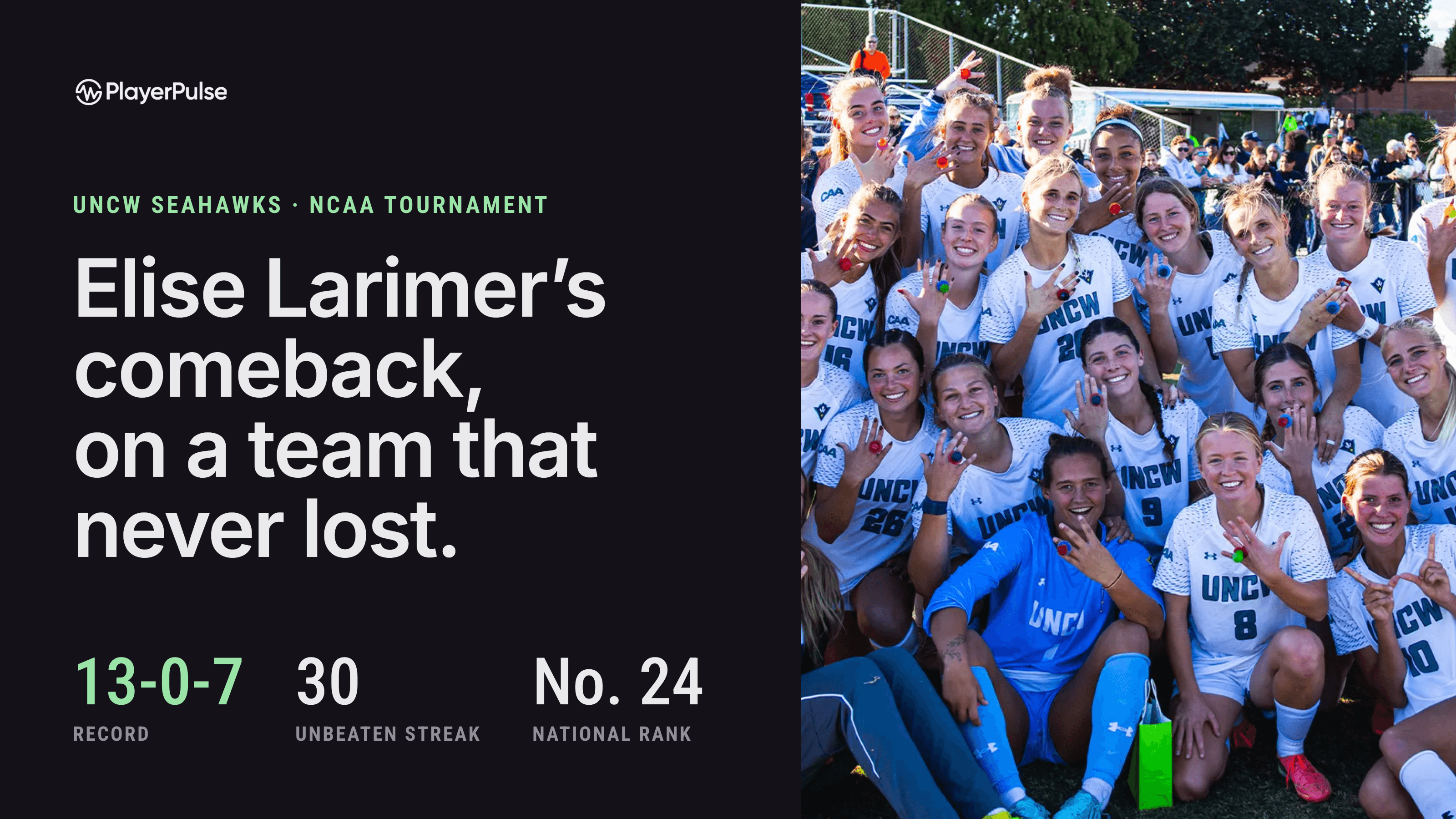
UNCW headed into the NCAA finals with a season that has made program history. The reigning CAA champions are 13-0-7, ranked No. 24 in the latest TopDrawerSoccer.com Top 25 poll, and carrying a 30-match unbeaten streak leading up to Saturday’s matchup with No. 11 Duke, the tournament’s third seed.
UNCW entered the postseason as the only unbeaten team in NCAA Division I.
For sophomore Elise Larimer, the season has been a long-awaited return, coming off of an ACL injury last summer.
Now even as far as the last week of October in Wilmington, it still is a beach season. Whether Elise treats a day as a beach day, is a separate question. She runs through a list in her head before chancing the sun burn: how practice went, whether she’s sleeping and eating well, whether her schoolwork is done, whether her body feels recovered.
“If I’m struggling at practice, beach day getting sunburned and dehydrated is probably not in my future,” she says.
Maybe a collegiate athlete's experience in that way has not changed over time; they’ve always had different responsibilities, and at times, less “beach days.” What’s changed though, is how much an athlete can now know about her own body, and how much of that information she can use to make decisions about training and recovery.
For Larimer and her teammates at the University of North Carolina Wilmington, that information has become part of the team’s daily routine. As the Seahawks prepared for the NCAA Tournament, their unbeaten season has been shaped by the work that happens throughout the week: monitoring recovery, communicating about how players feel, and making decisions that help the team stay healthy and ready to compete.
What’s also always been woven into the stories of generations of athletes before this particularly historic moment these Seahawks are experienced, is the bond between teammates. In Elise’s particular comeback story on the heels of a National Championship, is Grace Maynard.
Elise grew up in Cornelius, north of Charlotte, playing for a youth club with the same core of players for years. “Building a community within the soccer space has always kept me with it,” she says. Grace joined that group in eighth grade, and the two followed each other to Wilmington.
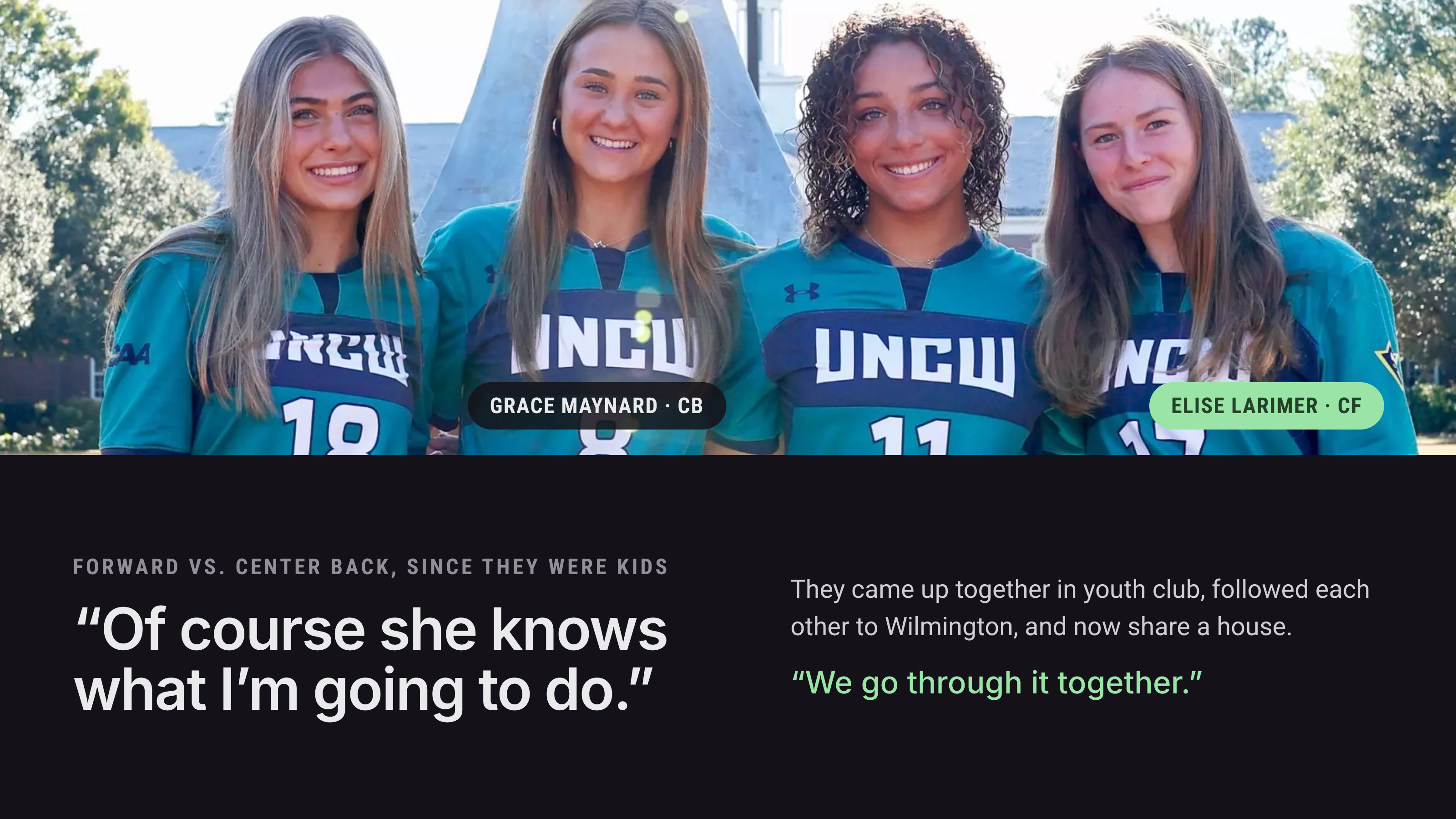
Elise plays center forward. Grace plays center back, which means in practice they line up against each other. A coach once told Elise that Grace knew exactly what she was going to do, so she needed to switch it up.
“Of course she knows what I’m going to do,” Elise says. “I’ve played with her since I was little.”
As freshmen, they chose not to room together so they’d each meet more people. This year they share a house. Neither has a sister, and at this point they’ve more or less filled that role for each other. In her recovery, she says, “Grace has been there encouraging me every step of the way.” Some of Elise’s closest friends are in a sorority, and they don’t always understand the daily demands of playing college soccer. On days her knee bothered her, their advice was to just push through tomorrow.
Of course, she knows better.
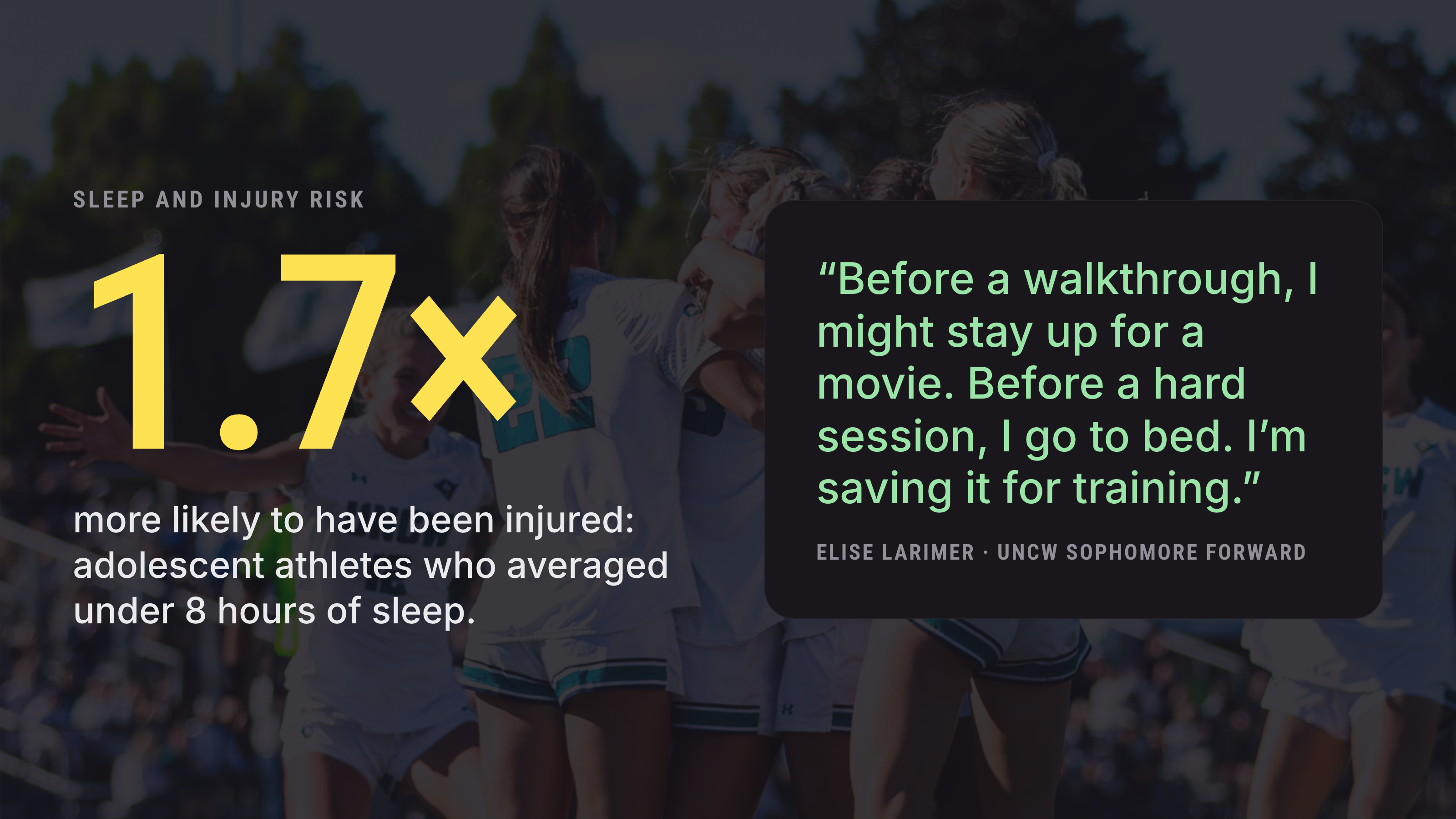
She knows before a walkthrough, she might stay up for a movie. Before a hard session, she goes to bed. “I’m saving it for training,” she says. “It’s nice, knowing my teammates get that, because not everyone will.”
The instinct holds up: in a study of adolescent athletes, those who averaged under eight hours of sleep were 1.7 times more likely to have been injured.
At UNCW, those choices feed straight into practice. Every player fills out a PlayerPulse wellness report each morning, and head coach Chris Neal’s staff plans sessions around them.
“They make their practice plans off PlayerPulse,” Elise says.
Neal described that approach earlier this year, after a 2025 season in which UNCW earned the top seed in the CAA tournament and no player missed a match to a soft-tissue injury. This fall, the Seahawks went further, becoming the first team in CAA history to finish a regular season unbeaten. Neal was named CAA Coach of the Year for the second straight season.
For much of the last generation, the standard answer to sore legs was “suck it up.” Elise’s generation has access to numbers about sleep, soreness, and readiness on their own phones, and a generation of coaches who are coaching differently than maybe they were themselves.
Those daily reports give the coaching staff another way to understand how players are feeling as the season progresses. With the CAA title secured and the NCAA Tournament ahead, the information continues to shape how the team prepares.
During her senior high school season, Elise spent two weeks in Spain with an Olympic Development Program national team, wearing the captain’s armband. She landed home at night, made her 7 a.m. class, and headed to the rivalry game.
Five minutes after her coach sent her in, before she’d touched the ball, she made a cut and tore her ACL.
She missed a full year, including her freshman season at UNCW.
The timing echoes her coach’s. In Neal’s playing days as a goalkeeper ended after a series of knee injuries during his senior year of high school and freshman year of college. More than thirty years apart, they experienced major injuries at almost the same point in their playing careers. Neal’s recovery took place in a very different era of sports medicine and athlete monitoring.
PlayerPulse itself grew out of a similar experience. Founder Matt Danaher, a Division I player at Fairfield, nearly lost his senior season to an overuse injury. He recalls the conditions to his injury to being almost identical. The tool he built later was intended to give athletes a better understanding of their bodies and the warning signs that can emerge during a season.
Elise says the hardest part of her recovery was learning to trust her knee again.
“You have to push yourself to trust your knee again,” she says. “You have to figure out what you are without your sport.”
Fear of reinjury is the reason athletes most often give for not returning to sport after ACL surgery. In rehab, Elise would be asked to do a single-leg hop, know her knee could handle it, and still hesitate. When she started running again, Grace was the first to congratulate her. “We go through it together,” Elise says.
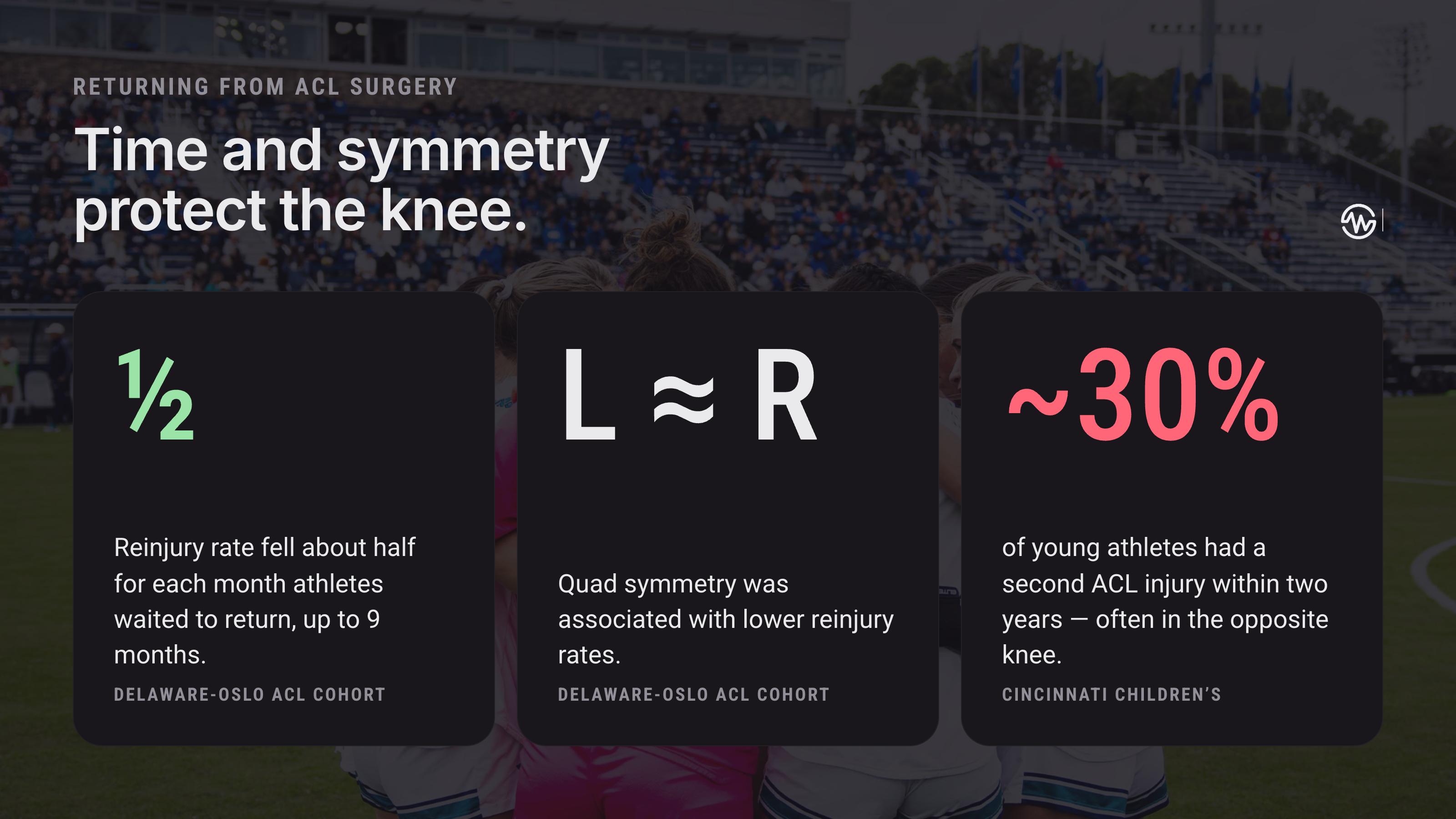
The year away likely helped. In the Delaware-Oslo ACL cohort, the reinjury rate fell by about half for each month an athlete waited to return, up to nine months after surgery. Elise has used PlayerPulse through nearly her whole recovery: at UNCW while she rehabbed, last summer with Fox Soccer Academy under PlayerPulse founder Matt Danaher, and now back with the Seahawks.
The daily reports became especially useful once games started. Elise was getting more sore than her teammates, and logging it helped her recognize a pattern.
“Why is my left quad getting more sore than my right in games?” she remembers asking herself.
That’s the kind of imbalance clinicians test for, and quad symmetry was one of the factors associated with lower reinjury rates in the Delaware-Oslo study.
She’s in the stretch where it counts most. A Cincinnati Children’s study found nearly 30 percent of young athletes had a second ACL injury within two years of returning, often early, and more often in the opposite knee than the repaired one.
Elise’s return has involved paying attention to those details, continuing her recovery work, and giving herself time to build confidence on the field.
In reflecting on her own comeback story being part of a historic team, squaring up for the national championship, she’s thankful. She adds, “If you don’t play, no one knows unless it’s game time and you’re cheering on the bench. We treat everyone the same on the team, and everyone’s part matters.”
The team’s approach to recovery makes those moments part of the weekly routine. Players understand that rest is built into the training schedule, and teammates continue to support one another through the season.
The relationship between coaches and medical staff can also have a measurable effect on player availability. A UEFA study of 36 professional clubs found that teams with poor communication between the head coach and medical staff had more injuries and fewer players available. A companion study found fewer severe injuries where coaches built trust and offered encouragement.
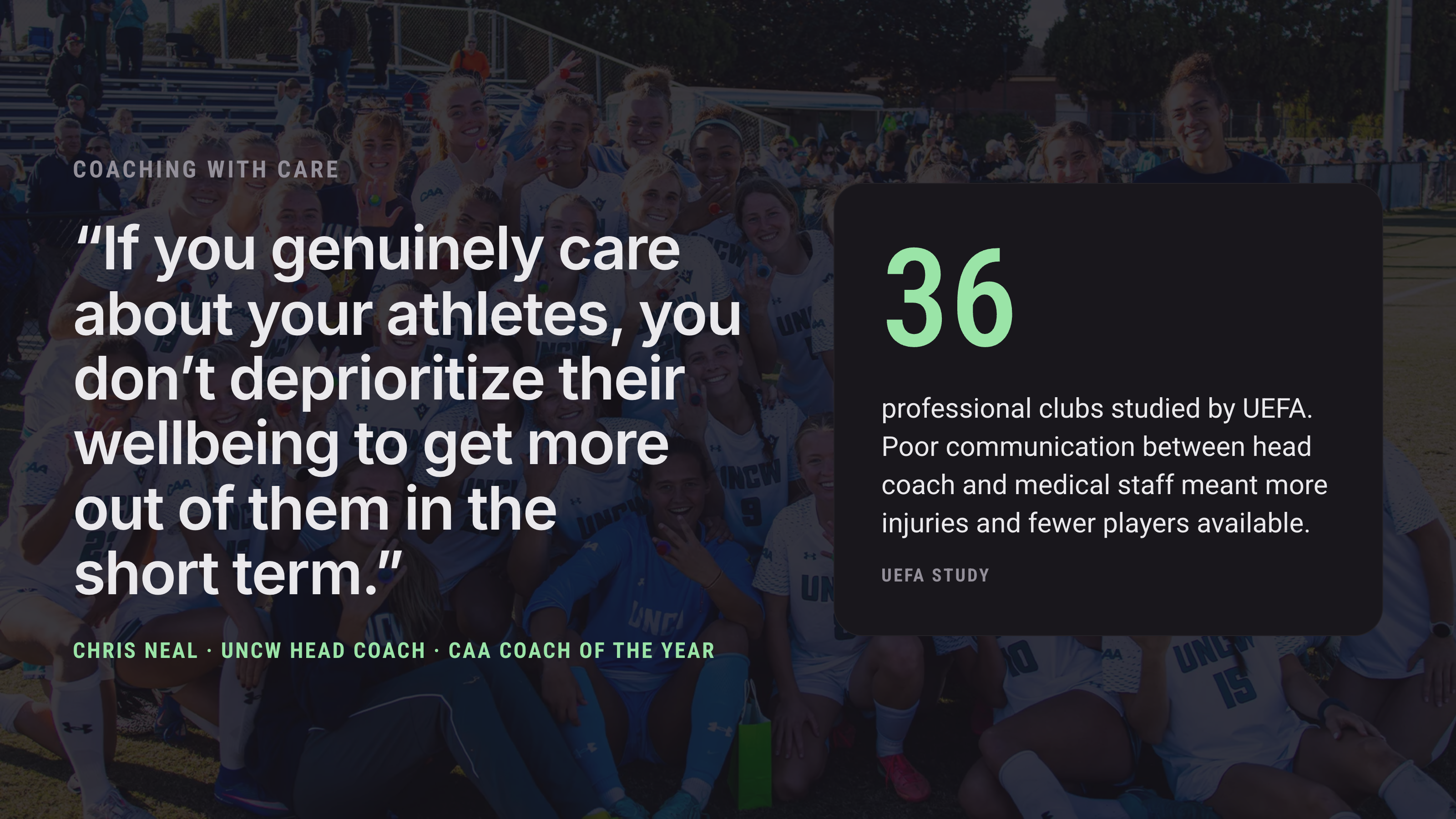
“If you genuinely care about your athletes,” Neal told PlayerPulse in June, “you don’t deprioritize their wellbeing to get more out of them in the short term.”
That approach has accompanied the Seahawks through a remarkable postseason. On Nov. 8, trailing William & Mary at halftime of the CAA semifinal, UNCW scored twice after the break to win 2-1. The Seahawks went on to claim the CAA championship, earning their place in the NCAA Tournament.
The team now carries a 30-match unbeaten streak into Saturday’s meeting with Duke. Through the season, UNCW’s players have contributed to a team that has stayed healthy, competed consistently, and kept finding ways to win. Its 13-0-7 record and No. 24 national ranking reflect what the program has built.
The culture gets passed down through the players. Hailey Longwell, the first UNCW player named CAA Attacking Player of the Year, has had two ACL tears and heats her knees before every practice.
“I’m like, oh, I probably should heat mine too,” Elise says. Caigan Leonard, a junior transfer and one of Elise’s closest friends, does recovery work every day. “What can I do to also match that?” Elise asks herself.
In a year or two, she’ll be the one someone younger is watching. And in a very real way, her comeback on this team will have a legacy.
That is part of how she has made peace with her ACL recovery. While this season has meant limited minutes, she had been training with the most talented team in conference, who happen to be her best friends and a ton of fun too. She has continued to train, learn from her teammates, and take part in a season that has brought UNCW to the national tournament.
Until recently, most players who want to train this way could only use PlayerPulse through their coach. Since October 13, any player can use it on their own, with sleep and heart rate data pulled from Apple Health and an optional view for parents.
Without a coach checking, the habit has to be the player’s, and Elise thinks the case for it starts with the training a team doesn’t control.
“It can help you plan your own workouts around team practices you don’t have control over,” she says. “Maybe I shouldn’t do legs right before practice if I’m too sore to give it my all. Doing too much is always an issue with athletes. You think, I need to go do this, I need to go do this. But it might actually make you worse.”
Elise is already thinking about how she’ll use what she’s learned after college. “You’re only an athlete for such a short period of your life,” she says. She plans to open her own gym, and she’s filing away everything she’s learned about recovery with that in mind. “Can people come to my gym every day,” she asks, “or do I need to put a recovery business within the gym?”
She thinks about how Matt as a coach, when he might raise voice at halftime, “It’s like the nicest yell ever,” has taught her that leadership that leads with care, like Neal, is all the more effective, and what she wants to emulate.
For Elise, getting back to soccer has meant a year of rehabilitation, learning to trust her knee, and finding her place in a team that has reached this moment together. The comeback has brought her here, alongside a best friend who has been part of the journey since they were kids.